Decoding Trinidad Rum: A Complete Guide to Caroni, TDL & Ten Cane Marks on Labels
If you've ever stared at a bottle of Caroni labelled "HTR" or a TDL release marked "TML" and wondered what the codes actually mean — you're not alone. Trinidad's rum mark system is one of the most opaque in the spirits world, and a lot of what's printed on labels is community knowledge or broker shorthand rather than official documentation. This guide pulls together what's actually verifiable.
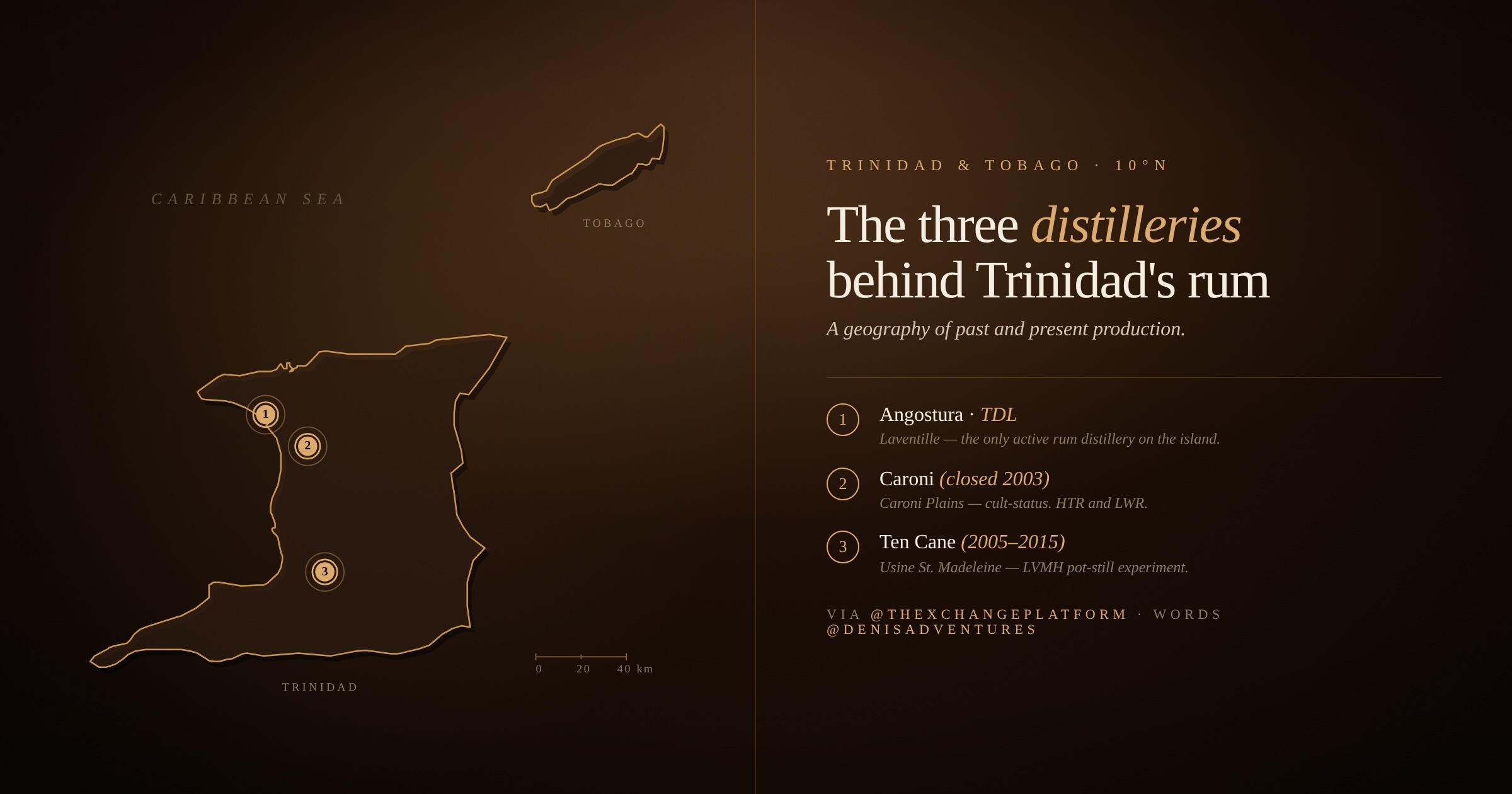
Trinidad is a small island with an outsized reputation in the rum world. Three distilleries have shaped its modern legacy:
Caroni, the cult-status closed factory whose remaining casks have made auction history;
Trinidad Distillers Limited (TDL), the active giant behind Angostura and the historic Fernandes brand; and
Ten Cane, an LVMH experiment that lasted barely a decade. Each of these has left behind a vocabulary of marks — three-letter codes, estate references, broker shorthand — that show up on labels and confuse even seasoned collectors.
The challenge: many of these marks are not officially documented. Some are factory designations. Others are broker codes from the Dutch firm Main Rum Company, the largest broker of Caribbean bulk rum, who use them to differentiate casks in their warehouses. Still others are historic estate names that have survived as style descriptors. Below is a walkthrough of what the marks mean, where they come from, and what's actually verifiable versus what's collector folklore.
Caroni's story is one of the most extraordinary in modern rum. The closure unfolded across three distinct dates, which is why both "2002" and "2003" show up legitimately on different documents: in 2000–2001, the Trinidad and Tobago government attempted to divest its stake, declaring Angostura the preferred bidder — though as Pietrek and Smith document in Modern Caribbean Rum, this purchase agreement was subsequently scuttled and Angostura never owned any portion of the distillery. Final distillation took place in 2002. Legal liquidation followed on 31 July 2003, when Caroni 1975 Ltd's rum operations were restructured into the Rum Distillers of Trinidad and Tobago. Distillation never resumed.
The distillery established circa 1918 had run for roughly 85 years. What looked at the time like the end of a working distillery turned out to be the beginning of a collector frenzy — largely thanks to Italian bottler Velier, who acquired significant cask stocks (alongside Angostura and The Main Rum Company) and released them gradually over the following two decades. Today, original Caroni bottles regularly trade at multiples of their release price.
A point worth flagging: while today's collectors associate Caroni almost exclusively with heavy, oily, diesel-like rum, the distillery historically produced a much wider range of styles. A 1950s Caroni advertisement described the rum as "more like whisky, with a dry, light and delicate flavour all its own." That range is reflected in the distillery's still inventory documented in Modern Caribbean Rum (Pietrek & Smith): a cast-iron still from 1918, a wooden Coffey still added in 1936, a single-column still from Esperanza Estate brought in for high-ester rum in 1957, a Blair two-column still plus a pot still in 1964, and a four-column Gebr. Herrmann still in 1980. That hardware diversity is part of why the marks system encodes more than just "heavy" — Caroni made light, heavy, high-ester, and pot still expressions across its operational decades.
Because Caroni is closed, its core marks are historically anchored. There are no new marks being introduced.
- HTR — Heavy Trinidad Rum. The flagship heavy style: pungent, oily, full of the rubber-and-tar character Caroni is famous for, produced through lower rectification in the column still, resulting in higher congener levels. By far the most common mark on Velier labels and on indie releases from Bristol, Berry Bros & Rudd, Cadenhead, That Boutique-y Rum Company, S.B.S., Compagnie des Indes, and others.
- LTR — Light Trinidad Rum. The column-still lighter cousin. Historically the larger share of Caroni's actual production, though it appears on far fewer collector labels than HTR.
- LWR — Light or Local White Rum. Per Caroni community expert Stefano Caroni. (Earlier reference works also describe an "LWR" style, sometimes interpreted as Light Wood Rum aged in steel tanks with wood chips; the "Light or Local White Rum" reading appears to be the more authoritative.)
- BTR — Blended Trinidad Rum. A pre-cask blend of HTR and LTR stocks. This appears written in full as "BLENDED" on Caroni casks and is an official production designation.
Worth knowing about, because they appear in auction catalogues and retailer listings: "Heavy Caroni" / "Light Caroni" and "HTR-LTR" are broker and trade shorthand, not official Caroni production marks. They were popularised after closure as casks moved through secondary markets. "Heavy Caroni" generally refers to HTR stock, "Light Caroni" to LTR or LWR stock, and "HTR-LTR" indicates blended stock. Useful as buyer's vocabulary but don't expect to find them in distillery production records.
A note on two terms that appear in collector circles: Felicite and Providence. Community expert Stefano Caroni has described both as Caroni marks — Felicite as a molasses-source designation linked to Felicite Estate, and Providence as the pot-still expression. Bristol Spirits has released a "Felicite Gold Caroni" exploring a profile beyond typical HTR character.
However, more recent community documentation argues these are estate names (estates that supplied molasses to Caroni — Felicite, Providence, Orange Grove, Brechin Castle, and Esperanza are all cited as molasses suppliers) rather than production marks, on the grounds that Caroni was a centralised government distillery that did not create estate-specific marks. Pietrek and Smith's Modern Caribbean Rum, the most thoroughly researched modern reference, doesn't list either Felicite or Providence as Caroni marks in its mark inventory.
We're flagging this honestly: collectors will encounter both terms on bottles and in discussion, but whether they are marks or estate references is currently contested in the community. If you have primary-source documentation either way, get in touch.
Steffen Mayer, author of the definitive Caroni 100% Trinidad Rum reference book, has stated that more marks exist beyond the obvious HTR/LTR/LWR core. The vocabulary is richer than canonical three-letter codes suggest — but exactly how it's organised is still being mapped.
Why this matters for collectors: Caroni stocks are finite and depleting. Every release shrinks the available pool, and HTR-marked heavies consistently outperform lighter expressions at auction. Knowing the marks isn't trivia — it's a pricing signal.
TDL is the active backbone of Trinidad rum production. It owns Angostura, produces the bulk of the rum that leaves the island, and inherited the historic Fernandes brand and its Forres Park estate distillate when it acquired Fernandes Distillers in 1973. The bulk of TDL's output is sold as bulk rum to brokers and independent bottlers around the world.
Here's where things get interesting. TDL rarely prints marks on their own bottles. The marks below come from two distinct sources, both essentially external to TDL itself:
Crucially, even within the collector community, these marks are not consistently applied. Heavy 2001 TDLs and soft caramelly TDLs from other vintages can both be marked "TML" — meaning the mark is more a sourcing reference than a reliable style indicator. Treat it as useful context, not gospel.
While most marks seen on TDL bottlings originate from broker conventions (TML, TMAL, TMAH, FPH), there is one documented example that proves TDL itself used an internal production mark system comparable in logic to Caroni's HTR/LTR classification.
A trade document from E&A Scheer — the Amsterdam-based broker that has handled bulk rum trade since 1712, and one of the most authoritative sources on Caribbean rum provenance — for a 2010 TDL parcel lists the mark MTA5.
This is not a broker code. It is a genuine distillery production classification.
The structure is highly revealing:
M T A 5 -> M = Molasses base - T = Trinidad - A = Angostura (TDL) - 5 = congener / ester class
This proves that TDL internally classified its distillates by congener profile using a numbered system, in the same functional way Caroni used HTR and LTR.
MTA5 is the only publicly surfaced example, because TDL never printed these marks on bottles and they only appear in bulk trade documentation. Logically, the existence of "5" implies a wider MTA-series (MTA1, MTA2, MTA3, MTA4, etc.), though no further examples have surfaced publicly.
This distinction is critical:
- TML / TMAL / TMAH are broker warehouse codes.
- MTA5 is a true distillery production mark.
These are the most commonly seen on TDL indie bottlings. They originate with Main Rum Company, not with TDL itself. Worth flagging: Main Rum's role in Trinidad rum is bigger than typical broker shorthand suggests. Modern Caribbean Rum documents that the Trinidadian government selected Main Rum in 2000 as the official valuer of Caroni's 18,000+ casks of remaining stock, and Main Rum was itself a purchaser of Caroni casks alongside Velier and Angostura. So the codes below aren't just convenient warehouse labels — they're tied to the firm that handled both the Caroni dispersion and ongoing TDL bulk:
- TML — Trinidad Main Light. The standard light column distillate.
- TMAL — Trinidad Main Angostura Light. Light style, Angostura-specific stock.
- TMAH — Trinidad Main Angostura Heavy. Heavier Angostura stock with more body.
You'll see these on bottles from Cadenhead, RomDeLuxe Wild Series, Rumclub Private Selection, Compagnie des Indes, and many others.
Forres Park is a historic Trinidad sugar estate that Joseph Bento Fernandes purchased in 1933 — buying the defunct distillery and its wooden still along with it, which Fernandes used to learn how to distill. By the early 1970s, Fernandes' Laventille distillery produced 85% of the rum sold in Trinidad. In 1973, Fernandes sold its distilling operations to Angostura and Bacardi, which is how the Forres Park distillate ended up in the TDL/Angostura production family. The mark survives on certain modern indie releases that source Fernandes-style distillate:
- FPH — Forres Park Heavy. Documented on several independent bottlings. Confirmed on labels including That Boutique-y Rum Company's Fernandes 1999 and 2006 releases.
- FP / FPM — Forres Park (standard) and Forres Park Medium. Reported as style references in the same family, though appearing on labels less often than FPH. Other FP variations appear sporadically but are not consistently documented as formal marks.
- Fernandes — A legacy brand designation occasionally used by TDL or indie bottlers to flag distillate from the Fernandes/Forres Park lineage. Typically a light column style.
There's no published TDL "marks dictionary." Some collectors and bottlers use additional codes (variations on TDL with appended letters, for example) but their meaning is inconsistent across sources. If a bottle carries an unfamiliar TDL-prefixed code, the safest interpretation is that it indicates a specific cask selection or bottler convention rather than a standardised TDL taxonomy.
Ten Cane is the outlier on this list — and arguably the most curious entry in modern Trinidad rum history. It was an LVMH-backed project distilled in the early 2000s at Usine St. Madeleine in south-central Trinidad, in collaboration with Angostura, who provided logistical support and facilities. Production focused on fresh sugar cane juice distilled in pot stills, which is dramatically untypical for Trinidad. The result is closer in profile to a Caribbean rhum agricole than to anything Caroni or TDL produced. Production later moved to Foursquare in Barbados before LVMH shuttered the brand entirely.
Because production has stopped and stocks are limited, Ten Cane is increasingly collectible — though it occupies a different niche than Caroni. It's not pursued for heavy ester power but for its grassy, vegetal singularity.
Marks attributed to Ten Cane (TC, TCR, 10C) appear primarily on independent bottler labels rather than official Ten Cane releases, since the brand itself is dormant. As with the TDL marks, these are more sourcing or style references than a formalised system, and any 10C designation in particular is worth paying attention to as a pot-still expression.
Trinidad rum marks exist for the same reason French wine appellations or Scotch whisky region designations exist: they encode information about source, style, and production method in compressed form. The problem is that, unlike those other systems, Trinidad's marks emerged organically — partly from factory practice, partly from broker warehouse codes, partly from independent bottler convention — rather than being codified by a regulatory body or trade association.
Caroni's marks are best documented because the factory left behind paperwork and because Steffen Mayer's research has surfaced what was available. TDL's marks are largely broker shorthand that floated downstream onto indie labels — with the rare exception of MTA5, which gives us a glimpse of TDL's own internal classification system. Ten Cane's marks are mostly the work of independent bottlers piecing together what they could from a short-lived operation.
For collectors and serious buyers, the practical takeaway is this:
If you collect, sell, or write about Trinidad rum, this is a starting point — not a closed system. There are open questions worth thinking about:
- Beyond HTR, LTR, and LWR, what other Caroni marks have actually appeared on bottles you've handled? Photos and label scans would advance the documentation enormously.
- Are there primary-source documents from TDL or Angostura that could move some of these from "convention" to "confirmed"?
- Are there other MTA-series marks (MTA1–MTA4, MTA6+) documented in trade paperwork that could complete the picture of TDL's internal classification?
- Do the Main Rum Company broker marks (TML family) correspond to genuinely distinct production styles, or are they essentially warehouse organisational codes that happened to land on consumer labels?
- Has anyone produced a comprehensive Forres Park / Fernandes mark inventory beyond FPH?
The Trinidad rum mark system is still being written, in real time, on labels and in auction catalogues. Documenting it carefully now means future collectors will have a clearer map than the one we've been working with — and being honest about what's verified versus what's collector folklore is part of building that map.
This guide will be updated as new information surfaces. If you have label photos, primary sources, or corrections to contribute, get in touch.
With thanks to community expert Stefano Caroni and bottler Bristol Spirits Ltd for input that informed the LWR clarification and surfaced the ongoing Felicite/Providence question for this revision. The historical and production-context material in this guide draws on Matt Pietrek and Carrie Smith's Modern Caribbean Rum (Wonk Press, 2024).
Written by our contributor @denisadventures
All rights reserved @denisadventures and @thexchangeplatform
Pubblicato su :
Modificato il :