Chartreuse: The Monks, the Manuscript, and the Bottle That Tells You Its Own Age
Few spirits carry as much history per centilitre as Chartreuse. A 17th-century manuscript no one could read, a monastic order older than the Magna Carta, an expulsion, a landslide, a Spanish festival that still drinks 15,000 bottles in ten days, and a code on the cap that lets you date any bottle made since 1991. This is the full story — and the collector's cheat sheet that goes with it.
Chartreuse is the only major liqueur in the world still made by the religious order that invented it. Two Carthusian monks — and only two at any given time — know the full recipe. They blend the 130 plants by hand inside the monastery, then send the sealed mixture to a distillery a few kilometres away, where lay staff handle the alcohol but never see the formula. Everything about the liqueur, from its name to its colour to the year on its label, traces back to events that started nearly a thousand years ago.
Here is what every collector should know.
The story doesn't begin with the recipe. It begins with a hermit.
In 1084, a German theologian named Bruno of Cologne — already a respected scholar at the Cathedral School of Reims — left everything behind to settle with six companions in a remote valley in the French Alps, north of Grenoble. The site was called the désert de Chartreuse, a wild stretch of mountain that gave its name to both the order and, eventually, the liqueur. The Carthusians (in French, les Chartreux) became one of the strictest monastic orders in Western Christianity: a life of silence, solitude, prayer, and self-sufficiency.
That last principle matters. Carthusian rule requires monasteries to support themselves through their own labour. Over the centuries this meant woodcutting, metalwork, beekeeping, herbalism — and eventually, a liqueur. The year 1084 is also the number every collector should commit to memory, because it is the key to dating any modern bottle of Chartreuse. We'll come back to it.
In 1605, at the Carthusian house of Vauvert on the outskirts of Paris, a French nobleman named François-Annibal d'Estrées handed the monks a manuscript. It contained the recipe for an Elixir of Long Life — a blend of more than 130 plants, flowers, roots, barks, and seeds. Where d'Estrées got the document remains unknown to this day. The Carthusians had a reputation as apothecaries, so it was natural enough that he brought it to them.
The recipe was almost too complex to execute. For more than a century the monks struggled with it. It wasn't until 1737, when the manuscript had been transferred to the Grande Chartreuse monastery, that the apothecary Brother Jérôme Maubec finally cracked it. He produced the first stable version of what became the Elixir Végétal de la Grande-Chartreuse — a 69% ABV medicinal tincture still sold today in its distinctive small wooden case.
The recipe was fixed definitively in 1764, and it hasn't meaningfully changed since.
The year 1605 still appears on every bottle of Chartreuse made today. It's the most symbolic date in the entire history of the brand and the reason a special bottling — Liqueur d'Elixir 1605 — was released to commemorate the gift of the manuscript.
For most of the 18th century the Elixir was sold as medicine, distributed from mules around villages near the monastery. It got a major boost during the 1832 cholera epidemic, when it was used widely as a remedy. But the monks understood early that a milder version could be a real liqueur in its own right.
In 1840, two new products were born:
- Green Chartreuse (originally 55% ABV), launched under the name "Liqueur de Santé" — the Health Liqueur. Its intense green colour comes entirely from chlorophyll extracted from the plants. It remains the only major naturally green digestif on the market.
- Yellow Chartreuse (today 43% ABV, milder and sweeter), nicknamed La Reine des Liqueurs — "The Queen of Liqueurs." The nickname comes directly from Tsar Nicholas II of Russia, who was a devoted drinker of the Yellow at the Imperial Court between roughly 1860 and 1903. His enthusiasm — passed along through the Court's dinner tables across Europe — is what gave the liqueur its royal title, which it has carried ever since. Same plant base as the Green, different alcoholic strength, different maceration, different colour — yellow from saffron.
A note on strength: standard Yellow Chartreuse was historically bottled at 43% until 1973, when it was lowered to 40% for fiscal and tax reasons. In 2021, after a 45-year absence, Chartreuse Diffusion brought the Yellow back to its original 43% globally — explicitly to recover the aromatic balance of the legendary Tarragona and old Voiron bottlings. Every standard Yellow Chartreuse made since the 2021 "Nouveau Tirage" is at 43%.
A third, less famous expression existed too: White Chartreuse, sold between 1860–1880 and again 1886–1903, at 43% and later 37% ABV. The colour was achieved by skipping the final tinting maceration. It never sold as well as the green or yellow and was discontinued at the time of the 1903 expulsion. Today, original White Chartreuse bottles are among the rarest collectibles in the entire category.
The Chartreuse brand was formally registered in 1852. By the late 19th century the liqueur was being exported all the way to the court of Tsar Nicholas II.
This is one of the most-asked questions among Chartreuse collectors: how many distilleries have there been? The answer is seven, and the seven host cities are today united by the official Pacte d'Amitié Chartreuse® — the Chartreuse Friendship Pact, a charter recognising each commune's historic role in producing the liqueur.
Per the official Chartreuse Diffusion / Fêtes de la Chartreuse records, the seven sites and their precise dates of distillery activity are:
Bottles from each of these production sites are collected separately. Fourvoirie bottles (pre-1935) are extremely rare. Tarragona bottles (1904–1989) form their own dedicated collecting category — more on this below.
The early 20th century brought one of the most dramatic episodes in the history of any spirit.
France in the 1890s and early 1900s was in the grip of aggressive anticlericalism. The Waldeck-Rousseau law of 1 July 1901, and especially its Article 13, required all religious congregations to obtain authorisation from the state to operate. The Carthusians were refused. On 29 April 1903, French soldiers arrived at the Grande Chartreuse to forcibly expel the monks. Several thousand local people protested. Some of the army officers ordered to carry out the operation refused — a captain and a commander of the French Dragoons resigned, with the latter calling it "a bandit's job."
The monks fled to Italy first, then to Spain, taking the recipe with them. The Fourvoirie distillery and the Chartreuse brand were nationalised and sold to a private French company — the Compagnie Fermière de la Grande Chartreuse — which tried to produce its own "Chartreuse" using staff who didn't have the recipe. The result was so inferior that it was mockingly nicknamed "liquidatreuse". The company went bankrupt in 1929.
In a remarkable gesture, a group of friends and merchants in Voiron bought up the worthless shares at rock-bottom prices and gifted them to the exiled monks. The Carthusians had their brand back.
The Spanish chapter is the longest single-location run in Chartreuse history — 86 years.
After the expulsion, the father distillers opened a new facility in Tarragona, Catalonia. Within a year they were back on the world market. Because they had lost the right to call the liqueur "Chartreuse" in France, the bottles carried an additional label reading Liqueur fabriquée à Tarragone par les Pères Chartreux ("Liqueur made in Tarragona by the Carthusian Fathers"). In France, the bottles became known simply as "Tarragone." If you wanted the real thing during this period, you asked for "une Tarragone" and the bartender knew exactly what you meant.
Tarragona continued to produce even after the monks returned to France in 1929 and resumed distillation at Fourvoirie. The two sites ran in parallel for most of the 20th century. The civil war years were difficult — the Tarragona distillery was bombed in 1938 — but production survived.
1989 was the end. Sales had declined, two parallel distilleries could no longer be justified, and the operation was consolidated back in France. The Tarragona buildings were sealed off; the ageing warehouse and bottling hall were later converted into a language school. The stills remain inside, intact but inactive.
Tarragona bottles are now one of the most desirable categories in the entire Chartreuse collecting world. Within Tarragona, several sub-eras and special bottlings are worth knowing:
- La Fabiola — a special Green Chartreuse produced in Tarragona between 1966 and 1973, in honour of Queen Fabiola of Belgium, the Spanish-born aristocrat who had married King Baudouin in 1960. Her popularity in Catalonia made the bottling a natural commercial tribute from the Tarragona distillery.
- The "double-label" period of 1930–1941, when bottles carried both "Chartreuse" and "Tarragone" markings during the brand recovery years.
- Various cap colours, seal types, and export sub-labels (notably the Export Argentine and Licor Cumbre bottlings for the South American market).
The monks regained Fourvoirie in 1929 and resumed distillation in 1932. The reprieve lasted three years.
On the night of 14 November 1935, a massive landslide came down the mountainside and destroyed the Fourvoirie distillery. Buildings were ruined; part of the stock washed into the river below. The French army was called in to help recover what could be saved. Crucially, the oak barrels and the large copper stills survived in usable condition.
What happened next is one of those quietly remarkable details: the French government — the same state that had expelled the monks 32 years earlier — sent army engineers to help relocate the operation. The salvaged barrels were rolled down to Voiron, a town some 15 km away where the Carthusians already owned a small warehouse and an ageing cellar. The famous foudres in the Voiron cellar today still sit on their sides because they had to be tipped to fit through the doorways in 1935. They have not moved since.
Production resumed in Voiron in 1936. The monks were officially allowed to return to the Grande Chartreuse monastery in 1940, by a decree of Georges Mandel. The expulsion order was formally lifted after the Liberation in 1945.
When Tarragona closed in 1989, the city did not let go.
For more than 85 years Chartreuse had been a Tarragonan product as much as a French one. The Carthusian distillery was woven into the fabric of the city, and the liqueur became the official drink of the local patron saint's festival: Santa Tecla, held every year from around 13–23 September, with the saint's feast day on the 23rd.
The festival drink is the Mamadeta — a slushy of equal parts Green Chartreuse, Yellow Chartreuse, and lemon granita. (Catalan speakers will recognise the literal meaning of the word; the Tarragonans take it in stride.) During the ten days of Santa Tecla, an estimated 15,000 bottles of Chartreuse are consumed across the old town. The festival features the city's famous castells (human towers), correfocs (fire runs), and the Baixada de l'Àliga procession, with Chartreuse flowing through it all in plastic cups and branded squeeze bottles.
Despite production having moved entirely to France, the bond is maintained. The president of Chartreuse Diffusion travels from Voiron to Tarragona every year to attend a special dinner hosted by the mayor. And — most importantly for collectors — Chartreuse releases dedicated Tarragona bottlings every year for the festival:
- Santa Tecla edition (since 2000) — both Green and Yellow versions, each carrying a unique illustration on the label tied to that year's festival emblem. Note: although Tarragona stopped producing in 1989, the annual labelled Santa Tecla editions only began with the 2000 vintage. Earlier festival bottles exist but without the now-iconic year-specific artwork.
- The Tau (since 2017) — the Chartreuse Épiscopale described above. A 70% Yellow / 30% Green blend at 44% ABV, dressed in the colours of the city and bearing the Tau cross. Effectively a pre-bottled Mamadeta. Production has typically run around 5,000–8,000 bottles per edition, sold exclusively in the Tarragona region.
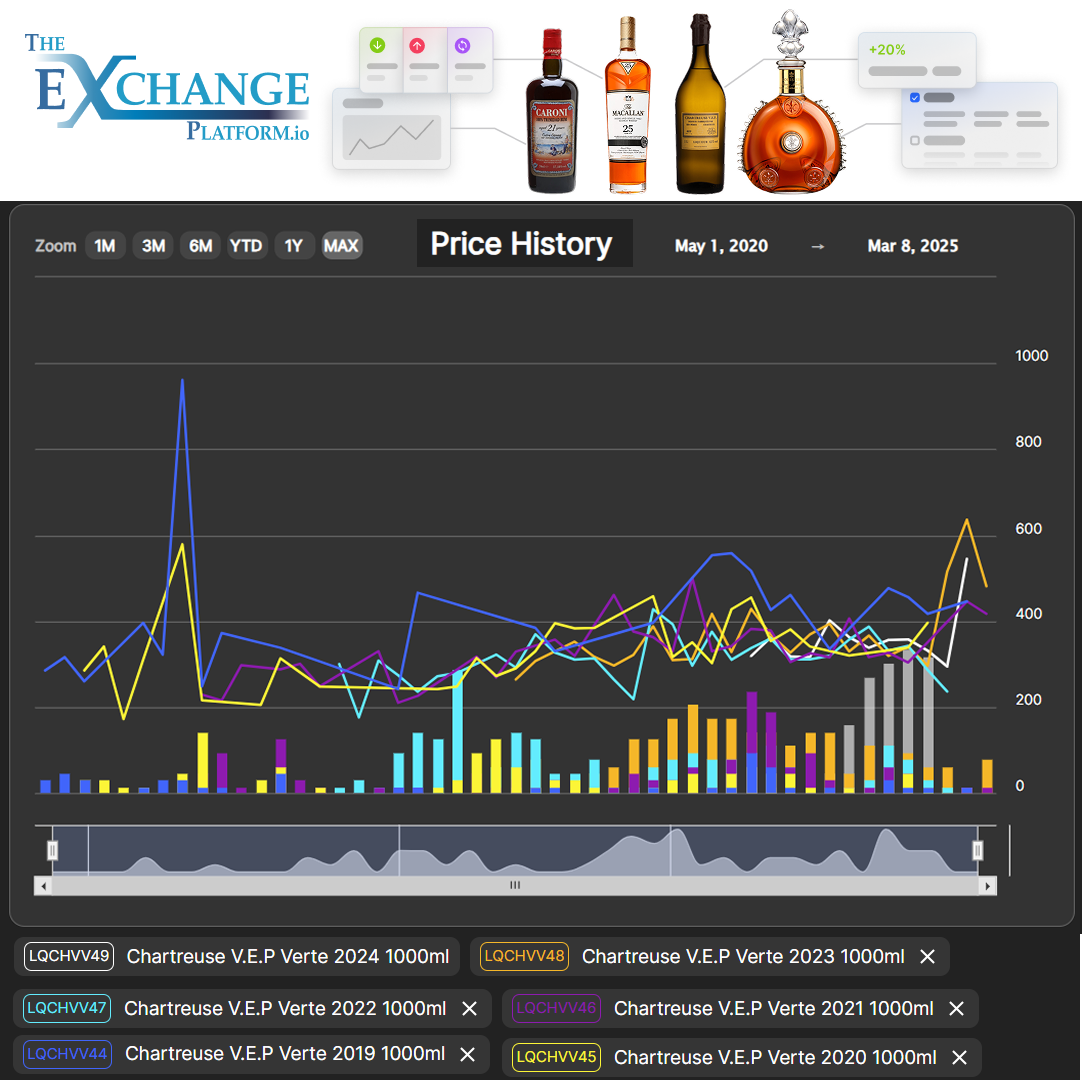
Chartreuse is unusual among liqueurs in that it continues to evolve in the bottle. Glass-aged bottles change measurably over decades — collectors describe Yellow Chartreuse as ageing into "liquid space honey," and old Greens taking on rich baked-spice and dark-fruit notes the modern versions don't have.
The official extra-aged line is the V.E.P. — Vieillissement Exceptionnellement Prolongé (Exceptionally Prolonged Ageing). It was launched in 1963. Standard Chartreuse is aged 3 to 5 years in oak; V.E.P. is aged anywhere from 11 to 20 years in smaller demi-muid casks. Each V.E.P. bottle is numbered. There is no age statement printed — but you can derive the bottling year using the cap code (see below).
Other notable specials (the date shown is when each cuvée was first introduced — most are still released regularly today):
- 9th Centenary (since 1984) — first released to mark 900 years of the Carthusian Order, re-released periodically
- Liqueur d'Elixir 1605 (since 2005) — created for the 400th anniversary of the manuscript
- MOF Yellow (since 2007) — developed in partnership with the Meilleurs Ouvriers de France Sommeliers
- La Reine des Liqueurs (since 2010) — Yellow at 43%, recreating the 19th-century recipe in honour of the Tsar Nicholas II nickname; produced in small numbered batches
- The Tau (since 2017) — a Chartreuse Épiscopale at 44% ABV, blending 70% Yellow and 30% Green, sold only in the region of Tarragona. The name refers to the Tau cross, the T-shaped symbol of the archbishopric of Tarragona. (Épiscopale — literally "of a bishop" — is the historic Catalan term for any cocktail or blend of Green and Yellow Chartreuse. The name dates back to the 1970s in Tarragona, when visitors to the distillery were served an "Episcopal" of Chartreuse and cava — Catalan sparkling wine — referencing the dual-colour vestments of a bishop. Today the term is used by Chartreuse Diffusion for any official pre-blended Yellow + Green cuvée.)
- Une Chartreuse (since 2015) — a perpetual-reserve cuvée drawing on the historic Voiron stocks, around 240 bottles released each year
- Foudre 147 (since 2019) — the only cuvée still aged at Voiron, drawn from a single historic cask, sold exclusively at the Voiron boutique
- Santa Tecla (since 2000)
The Modern Era: Chartreuse Diffusion (1970) and the Return to Paris (2023)
Two dates define the modern chapter.
In 1970, the Carthusian Order created Chartreuse Diffusion, a separate company tasked with everything the monks didn't want to handle themselves: marketing, packaging, bottling logistics, distillery operations management, tourism, and sales. The monks kept the recipe and the plant blending — full stop. Everything else became Chartreuse Diffusion's job. Today the company employs around 80 people, generates roughly €30 million in annual revenue (about half of it from exports), and is led by Emmanuel Delafon. It is the entity that decided to cap production at 1.6 million bottles per year in 2019, and it operates every commercial site associated with the brand.
The second date is 28 November 2023. On that day, Chartreuse Diffusion inaugurated Chartreuse Paris-Vauvert, the brand's first ever Paris location and only its second cultural site outside the Voiron cellars. The address is no accident: 128 boulevard Saint-Germain, in the 6th arrondissement (Métro Odéon), a few minutes' walk from the Luxembourg Gardens — exactly where the Chartreuse de Vauvert monastery once stood. The Carthusians had lived on that ground from 1257, when they were invited to Paris by King Louis IX, until the French Revolution destroyed the monastery. It is the very site where Maréchal d'Estrées handed over the 1605 manuscript. The trees you see today in the Luxembourg Gardens are descendants of the monks' original nursery.
The new venue spans two floors of 125 m² each (250 m² in total) and is closer to a museum-bar hybrid than a typical boutique. What you find inside:
- Museum spaces dedicated to the Carthusians' 500-year history in Paris, the development of the Elixir Végétal, and the monastic tradition of herbalism
- Original archives from the Chartreuse Order and the Vauvert monastery, including documents from the 17th and 18th centuries
- A historic Carthusian still that was used at the third distillery, Fourvoirie, before its destruction in 1935
- A collection of antique bottles and elixir flasks drawn from across the brand's history
- A boutique selling Green, Yellow, Elixir Végétal, Liqueur d'Elixir 1605, the MOF Sommeliers Yellow, and the 9th Centenary blend — limited to 3 bottles per customer (Paris is on the same allocation system as every other authorised shop since the 2019 production cap)
- A herbal tea range (tisanes) developed by Chartreuse Diffusion as a deliberate return to the monks' apothecary roots — blends for sleep, digestion, respiratory health, and muscular relaxation
- A bar area styled after early-1900s Paris, where the standard Chartreuse range can be tasted by the glass (closed Sundays)
- A hidden speakeasy on the lower level, available by reservation for private events and workshops
Bookable activities at the Paris site include:
- Guided walk through the Luxembourg Gardens retracing the 500 years of Carthusian history in Paris from 1257 to the Revolution, ending with a tasting back at the speakeasy (≈2 hours, around €19)
- Discovery tasting — a one-hour history immersion in the speakeasy paired with a guided tasting (around €45)
- Vertical tasting workshops — comparing different vintages and expressions of Chartreuse across the decades (≈2 hours, around €45)
- Tisane-blending workshops — hands-on sessions learning to assemble herbal blends from the monks' botanical tradition (around €95, weekends only)
All tours and workshops are bilingual (French / English). The boutique is open daily from 10:00 to 19:00, and on Sundays from 12:30 to 18:00 (the bar is closed on Sundays). Reservations for the experiences are handled via paris.vauvert@chartreuse.fr.
For collectors and serious enthusiasts, Paris-Vauvert is now the second pilgrimage destination after the Voiron cellars — and historically the more meaningful of the two, because it sits on the ground where the entire Chartreuse story began in 1605.
If Santa Tecla is Chartreuse's adoptive Spanish festival, Les Fêtes de la Chartreuse is its French equivalent — and a much younger tradition. The first edition was held in 2015, and the festival has run annually ever since, taking place every May around the symbolic date of the 16th, 16.05 is the official Chartreuse Day. The festival spans four to five days each year. The 11th edition runs from 13 to 17 May 2026.
The festival exists to celebrate what locals call the trilogie Chartreuse — "the Chartreuse trilogy":
Unlike Santa Tecla, which centres on a single city, Les Fêtes de la Chartreuse spreads across four host communes every year, all signatories of the Pacte d'Amitié Chartreuse®:
- Voiron — home of the Caves de la Chartreuse, where the festival's main events take place
- Saint-Pierre-de-Chartreuse — village of the monastery itself
- Saint-Laurent-du-Pont — site of the old Fourvoirie distillery
- Entre-Deux-Guiers — current home of the Aiguenoire distillery
The festival programme always includes a clin d'œil — a symbolic nod — to the three other Pacte d'Amitié signatory cities that once hosted Chartreuse distilleries but lie outside the massif: Paris, Marseille, and Tarragone.
There's a beautiful symbolic detail attached to the Pacte d'Amitié. Seven stars have been forged by local artisans, one for each of the seven host cities. They are made in Corten steel — an alloy chosen for two reasons: it recalls the metal of the stills used for distillation, and it nods to the historic forge work of the Carthusian monks (the order had a long metallurgical tradition before becoming distillers).
The seven stars also carry a deeper resonance: they recall the founding of the order in 1084, when, according to tradition, Saint Hugues, Bishop of Grenoble, dreamed of seven stars guiding Saint Bruno and his six companions to the désert de Chartreuse — the wild valley where they would settle and found the order. Seven stars, seven monks, seven distilleries, seven cities. During the festival, the seven stars converge on a common plinth in Voiron, representing the unity of the Pacte.
The programme typically includes:
- A grand defilé (parade) departing from the Caves de la Chartreuse and ending in the Voiron town centre
- A massive open-air banquet populaire seating up to 3,500 guests
- A son-et-lumière pyrotechnic show projected onto the façade of Saint-Bruno church
- A cocktail competition in Entre-Deux-Guiers, where a Chartreuse-based winner is unveiled on the Sunday
- Guided tours of the Caves de la Chartreuse at reduced rates, with the bar exceptionally open all week
- Conferences, exhibitions, and tastings on the Order, the massif, and the plants
- Visits to the old Fourvoirie distillery site at Saint-Laurent-du-Pont (now in ruins, but accessible during the festival)
A delightful detail of the festival is that three of its core elements are decided by public competition:
- Concours d'affiche (poster competition) — anyone can submit a design for the official festival poster. The jury, drawn from Chartreuse Diffusion, the participating mayors, and the local cultural community, selects the winner. The 10th edition (2025) had three competing designs in the final round. Each year's poster becomes a collectible in its own right, tied to that year's theme (2025: le végétal — the botanical world).
- Concours de vitrines (shop-window competition) — Voiron shopkeepers compete to decorate their storefronts in Chartreuse colours, with prizes awarded during the parade.
- Concours photo (photo competition) — visitors are invited to submit photographs from the festival itself, with the best images selected for the following year's communications.
Each year, Chartreuse Diffusion releases two festival-only items that have become collectibles in their own right:
- The Fêtes de la Chartreuse bottle — a dedicated bottling (Green or Yellow) with a unique label tied to that year's festival edition, sold primarily at the Voiron Caves and the festival venues. A French parallel to the Tarragona Santa Tecla editions, with the early editions (2015 onwards) becoming increasingly scarce on the secondary market.
- The Chartreuse foulard — an annual scarf made in Raidlight technical fabric (Raidlight is a French trail-running brand). The choice of Raidlight reflects the regional identity — the brand is based in Saint-Pierre-de-Chartreuse — and gives the foulard a useful, sporty character rather than a purely decorative one. Each year's foulard carries a distinct design.
For collectors, securing both the bottle and the foulard in matching years is now part of the annual ritual.
Here is a piece of trivia that holds up under scrutiny: Chartreuse is the only alcoholic beverage in the world to have given its name to a colour.
Think about it for a moment. Orange came from the fruit. Magenta from a battle. Burgundy from a wine region — not a wine. Champagne is sometimes called a colour but informally, and never with the linguistic standing of a real colour term. Cognac and bourbon are talked about as leather and shoe shades, but neither has been formally entered into the language as a colour. Chartreuse, on the other hand, is in every dictionary, every Pantone book, every paint catalogue, every fashion glossary.
The word entered the English language as a colour term in 1884, and the French usage is even older. The shade in question — a sharp, glowing yellow-green sitting halfway between lime and electric lemon — comes directly from the chlorophyll-derived hue of the Green Chartreuse liqueur. Painters had been using it for centuries (Fragonard, Van Gogh, the Impressionists all reached for it), but it was only after the liqueur's commercial success in the 19th century that the colour got its name.
There's a sub-shade too: chartreuse yellow, originally named simply "chartreuse" in 1892 after the Yellow version of the liqueur. Since 1987, it has been formally renamed "chartreuse yellow" to avoid confusion with the green chartreuse.
So when you order a Last Word at a bar in 2026, the colour of the cocktail in your glass is named after the liqueur that made it possible — a small piece of linguistic history that no other spirit in the world can claim.
This is the part collectors come for, and it is genuinely simple.
Since 1991, every bottle of Chartreuse has carried a six-digit lot code on the thin gold band at the top of the bottle (just below the seal). The code is preceded by the letter L, like this: L940032.
To decode it:
A bottle marked L940032 was therefore sealed on 1 February 2024.
This works for every bottle produced after 1991. For older bottles, you can't get a precise date, but you can narrow the era by looking at the importer listed on the back label.
The US importer history is the most thoroughly documented of any market, largely thanks to Tim Masters at Frederick Wildman & Sons, who has compiled the timeline below:
ImporterApproximate PeriodBatjer & Co.c. 1895 – ProhibitionShently1933 – c. 1940sSchieffelin & Sonsc. 1940s – 1969Sussex (James C. Sussex Ltd)1969 – 198121 Brands1981 – 1990Frederick Wildman & Sons1990 – present
A US-only detail worth knowing: silver caps were switched to black in 1980. Any US bottle with a silver cap is therefore pre-1980, regardless of importer.
France has its own internal lineage tied to the corporate history of the brand itself rather than a third-party importer:
OperatorPeriodPères Chartreux (direct, L. Garnier signature)1840 – 1903Compagnie Fermière de la Grande Chartreuse (counterfeit "liquidatreuse")1903 – 1929Carthusians as "Tarragona" / Marseille blends1921 – 1929 (parallel)Compagnie Française de la Grande Chartreuse1929 – 1970Chartreuse Diffusion1970 – present
Italian collectors will repeatedly come across one name: P. Soffiantino & Co., a historic Genoa-based importer. Soffiantino-imported Chartreuse bottles are dated from at least the mid-1970s through the 1990s, and the company also imported other premium spirits of the era (Bowmore, Appleton). A Soffiantino back label on an old bottle is a strong indicator of Italian-market provenance — and the bottles tend to surface frequently at Italian auctions.
UK distribution is currently handled by Cask Liquid Marketing (Ipsosolo Ltd). Older UK distributor history is less well documented in public sources than the US lineage — bottle hunters in Britain typically have to rely on the cap code (post-1991), production site, label design, and any UK retailer overstickers to date a bottle.
Spain didn't need an importer during the Tarragona years — production was domestic from 1903 to 1989. Spanish-market bottles from that era often carry different labels, festival editions (Santa Tecla), or local names like "El Licor Cumbre" and "La Fabiola." A significant portion of Tarragona's output was also exported to Argentina and Brazil, with specific "Export Argentine" markings on the back labels — these bottles still occasionally surface in South American estate sales and are sought after by collectors precisely because they rarely made it back to Europe.
Various 20th-century bottles also exist with German-language back labels marked "Export," confirming distribution into German-speaking markets. Documentation is sparse, but the bottles themselves are physical evidence of the export network.
Combine the importer name with the production location on the label (Fourvoirie, Tarragona, Marseille, Voiron, Aiguenoire), the alcoholic strength (Yellow was lowered from 86 proof / 43% to 80 proof / 40% in 1972 for the US market — note that the modern Yellow is back at 43%), and the cap colour, and you can usually pin a pre-1991 bottle to within a few years even without a lot code.
Three things came together to push Chartreuse from an obscure herbal digestif into one of the most collectable spirits on the market.
The first is the cocktail revival of the 2000s. Drinks like The Last Word (gin, maraschino, lime, Green Chartreuse, equal parts) and the Bijou put the liqueur back behind every serious bar in the world. Bartenders started hunting vintage bottles to taste the difference between modern and old.
The second is the 2019 production cap. The monks, citing environmental concerns and their commitment to monastic life, decided to limit annual production to roughly 1.6 million bottles. Global demand at that point was several multiples of supply. Suddenly Chartreuse — never a cheap liqueur, but always available — became scarce. By 2022, bars in major US cities reported being completely unable to source it. Prices on the secondary market climbed sharply.
The third is the in-bottle ageing. Unlike most distilled spirits, which are essentially stable in glass, Chartreuse keeps evolving. A bottle of Green Chartreuse from 1985 is not the same liquid as a bottle from 2025, even if both were filled at the same proof. Collectors who appreciate this — and the importers, like Tim Masters at Frederick Wildman, who have built tasting libraries spanning fifty years — treat Chartreuse closer to fine wine than to a typical spirit.
If you're hunting Chartreuse — at auction, in a dusty corner of a wine shop, in a relative's cabinet — here's what to look at:
- Cap code starting with L → modern bottle (post-1991), date it precisely
- No cap code → pre-1991, identify by importer and production site
- "Fabriquée à Tarragone" on the label → Tarragona bottling (1903–1989), automatically of interest
- "Voiron" on the label, no Tarragona reference → 1936–2017 French production
- "Aiguenoire" → 2018 or later
- Silver cap → signals an older bottling, often pre-1980s; an industry tip for "bottle dusting"
- Santa Tecla back label → annual limited edition, value depends on year and condition
- Numbered V.E.P. bottle → date via the cap code; older V.E.P.s with low numbers are especially prized
- White Chartreuse → if genuine and verifiable (pre-1903), one of the rarest in the category
There is no other spirit in the world quite like Chartreuse. The recipe predates most modern countries. The producer is a monastery older than the Tower of London. The bottle on your shelf was sealed on a specific day you can calculate, and the liqueur inside is still changing as you read this.
Whether you drink it neat after dinner, stir it into a Last Word, or set it aside in a dark cupboard to come back to in a decade, you are participating in a chain that runs from a manuscript handed to monks in Paris in 1605, through a forced exile, a landslide, a Spanish festival, and a recipe known to exactly two living people — and back to 1084, a year so old it's now hiding on the cap of your bottle.
For more on the liqueur, the order, the cellars, the Paris site, and bookable experiences:
For the annual French festival — programme, poster competition, history of the Pacte d'Amitié, and the seven stars:
Publicado el :
Modificado el :