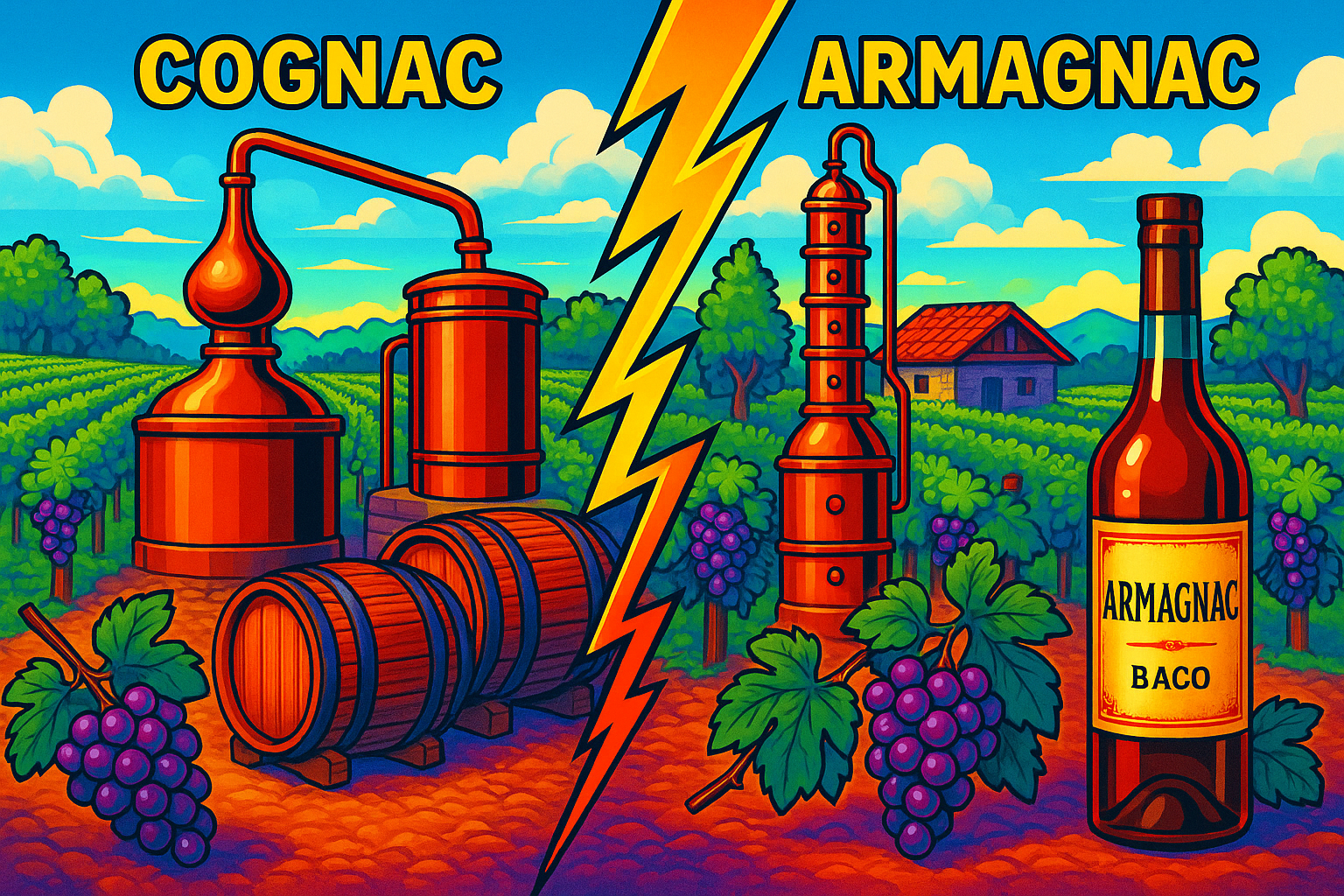
Cognac vs. Armagnac — Same Grapes, Different Souls
Cognac gets the spotlight. Armagnac keeps the soul.
Both are iconic French brandies — but the comparison stops there. If Cognac is the nowadays polished aristocrat born into global fame, Armagnac is the Gascon poet with muddy boots and roots sunk deep into the land. Still, beyond the major houses, Cognac remains a landscape of family-owned domaines and centuries-old savoir-faire.
1) Armagnac: The Gutsy Gascon Spirit
Origin & Terroirs
Long before Cognac conquered the world stage, Armagnac was already flowing in the heart of Gascony. Officially mentioned in a 1310 manuscript by Maître Vital Dufour, who praised its 40 medicinal virtues, Armagnac is France’s oldest recorded eau-de-vie.
Still today, Armagnac is deeply artisanal, produced by small growers and family-run estates who value craft over scale. It is protected by an AOC (Appellation d’Origine Contrôlée) status since 1936, which guarantees origin, traditional methods, and strict production guidelines.
Armagnac hails from Gascony, covering Gers (32), Landes (40), and Lot-et-Garonne (47). The AOC is divided into three official terroirs:
- Bas-Armagnac – sandy soils, finesse, and fruit
- Ténarèze – clay-limestone, known for power and structure
- Haut-Armagnac – chalky, rare, scattered vineyards
Grapes & Distillation
Ten authorized grapes, with Ugni Blanc, Baco 22A, Folle Blanche, and Colombard most common. Armagnac is distilled once using a continuous column still (alambic armagnaçais), retaining more congeners and giving a fuller, earthier profile.
ABV Regulations
For Armagnac, distillation must occur between 52% and 72.4% ABV, depending on the desired style and the still used. Once distilled, the spirit is typically reduced and casked at a strength between 52% and 62% ABV. Before bottling, it is brought down to a minimum legal strength of 40% ABV, as required by French and EU regulations.
Distillation Season – La Flamme de l’Armagnac
Running from October to January 31st, the distillation period is not only regulated but also celebrated. Known as La Flamme de l’Armagnac, this season features public tastings, rural feasts, and the unmistakable scent of brandy flowing through copper stills.
Aging & Compte d’Âge
Armagnac is aged in Gascon oak, yielding a spicy, bold character. It uses a similar age classification system:
- VS: 1Y minimum
- VSOP: 4Y
- XO / Hors d’âge: 10Y+
- Vintage bottlings: common and highly valued
Mixology & Culture
While often overlooked in classic cocktail books, Armagnac is a bartender's secret weapon — rich, soulful, and deeply complex. It's ideal for Old Fashioneds, Sours, or neat sipping. Though exports are modest (approx. 1.6 million bottles in 2018, with 58% going abroad), interest is growing in the U.S., China, Russia, and the UK, especially in craft and natural spirits circles.
Floc de Gascogne
Armagnac’s fortified wine cousin, Floc de Gascogne, is a mistelle made by blending grape must with young Armagnac. Often enjoyed as an aperitif, it is light, floral, and protected by its own AOC since 1990.
2) Cognac: The Refined Spirit of Charente
Cognac is more than a luxury spirit — it’s a symbol of French diplomacy, legacy, and craftsmanship.
Its roots stretch back to the 16th–17th centuries, when Dutch and English merchants encouraged Charentais winemakers to distill their wines for preservation. This practical export solution evolved into a refined art.
Napoleon Bonaparte had a known appreciation for Cognac and is said to have had barrels sent with him into exile — cementing the spirit's symbolic link to French imperial identity.
Cognac may be the more famous sibling, but its success is no accident. It is built on centuries of refinement, branding, and global positioning — with AOC status since 1936 and a strong governing body, the BNIC (Bureau National Interprofessionnel du Cognac).
Cognac is revered for its elegance, consistency, and global export strength — it is France’s largest spirits export by value.
Origin & Crus
Produced in Charente (16), Charente-Maritime (17), and parts of Dordogne (24) and Deux-Sèvres (79). The AOC defines six + one crus. Soils are chalky and limestone-rich, similar to Champagne, which gives the spirit its hallmark finesse and floral clarity:
- Grande Champagne: Known for producing eaux-de-vie with exceptional aging potential and floral notes
- Petite Champagne: Offers similar qualities to Grande Champagne
- Borderies: The smallest cru, known for its nutty and violet aromas
- Fins Bois: Produces round and supple eaux-de-vie that age relatively quickly
- Bons Bois and Bois Ordinaires: Yield more rustic and fast-aging spirits, often used in blends
- Fine Champagne – blend of Grande & Petite, with at least 51% Grande Champagne
Grapes
The primary grape used in Cognac production is Ugni Blanc, also known as Trebbiano Toscano, prized for its high acidity and low sugar content, which are ideal for distillation. Other permitted varieties include Folle Blanche, Colombard, Montils, Sémillon, and Folignan, each contributing unique aromatic profiles to the final spirit
Distillation Process
Cognac undergoes a double distillation process in traditional copper pot stills, known as "alambic charentais." The first distillation yields a liquid called "brouillis," which is then distilled a second time to produce the "bonne chauffe," resulting in a clear eau-de-vie with a maximum alcohol content of 72.4% ABV.
ABV Regulations
For Cognac, distillation is allowed up to a maximum of 72.4% ABV, which ensures the preservation of delicate aromatic compounds. The eaux-de-vie are generally casked at strengths ranging from 60% to 72% ABV, depending on the house's practice and barrel type. As with Armagnac, Cognac must be bottled at no less than 40% ABV.
Distillation Season – Campagne de Distillation
From November 1 to March 31, tightly regulated by the BNIC (Bureau National Interprofessionnel du Cognac) to maintain standards across vintages and houses.
Aging & Compte d’Âge
Aged in Limousin or Tronçais oak, Cognac follows a structured, transparent system:
- VS: 2Y (Compte 2)
- 3Y: Cuvée Supérieure, Qualité Supérieure
- VSOP: 4Y (Compte 4)
- 5Y: Vieille Réserve, Réserve Rare, Réserve Royale
- 6Y: Napoléon, Très Vieille Réserve, Très Vieux, Excellence, Héritage, Suprême (unofficial but widespread)
- XO: 10Y (Compte 10)
- XXO: 14Y (Compte 14)
Mixology & Cultural Identity
Cognac is a cornerstone of French luxury and a global cocktail icon. Bartenders value its depth in classics and new creations alike. In the United States, Cognac became a cornerstone of early American mixology. From the Sazerac and Brandy Crusta to the Sidecar, it left an indelible mark on bar culture that continues today.
Angel’s Share, Dame-Jeanne & Paradis
As it ages, these spirits lose up to 2-3% per year to evaporation — the “part des anges”.
Over time, evaporation perfumes the air and leaves blackened walls from natural microbial activity (baudoinia fungus) on cellar walls.
Storage Tradition – Dame-Jeanne
For especially rare spirits, producers may withdrawn from barrels and store to dame-jeannes (large glass demijohns) to stop aging and preserve its peak character.
The Paradis (term mostly used in Cognac) is where houses age their oldest eaux-de-vie — often for decades — in calm, humid cellars in Dame-Jeanne. Hence the reference to what’s the best.
Economic Significance
Cognac is a major contributor to France's export economy, with significant markets in the United States, China, and the United Kingdom. The industry supports thousands of jobs and encompasses numerous Cognac houses and winegrowers .
Pineau des Charentes
Like Floc de Gascogne, Pineau des Charentes is a fortified wine (mistelle) made by blending grape must with fresh Cognac eau-de-vie. It was born allegedly by accident, and now stands as an AOC-protected regional treasure enjoyed as an aperitif or in cocktails.
3) The Mystery of Rancio: Time’s Signature in the Cellar
One of the most prized and elusive notes in long-aged Cognac and Armagnac is rancio — a term that doesn’t translate easily, but every seasoned taster knows when they taste it.
Rancio refers to a complex, oxidative aroma and flavor that develops after long barrel aging, typically 15 to 20+ years. It is not a flaw, but a desirable evolution — often described with notes of dried fruit, walnut, mushroom, forest floor, old wood, leather, and even umami.
This character emerges from a delicate combination of:
- Oxidative reactions in old, semi-porous oak barrels
- Maillard reactions during long maturation
- The interaction between spirit, wood, and humid cellar conditions (chais humides)
Rancio is a sign not just of age, but of patience and respect for time. It’s what separates a merely old spirit from a truly transcendent one.
4) Dedicated Festival and show
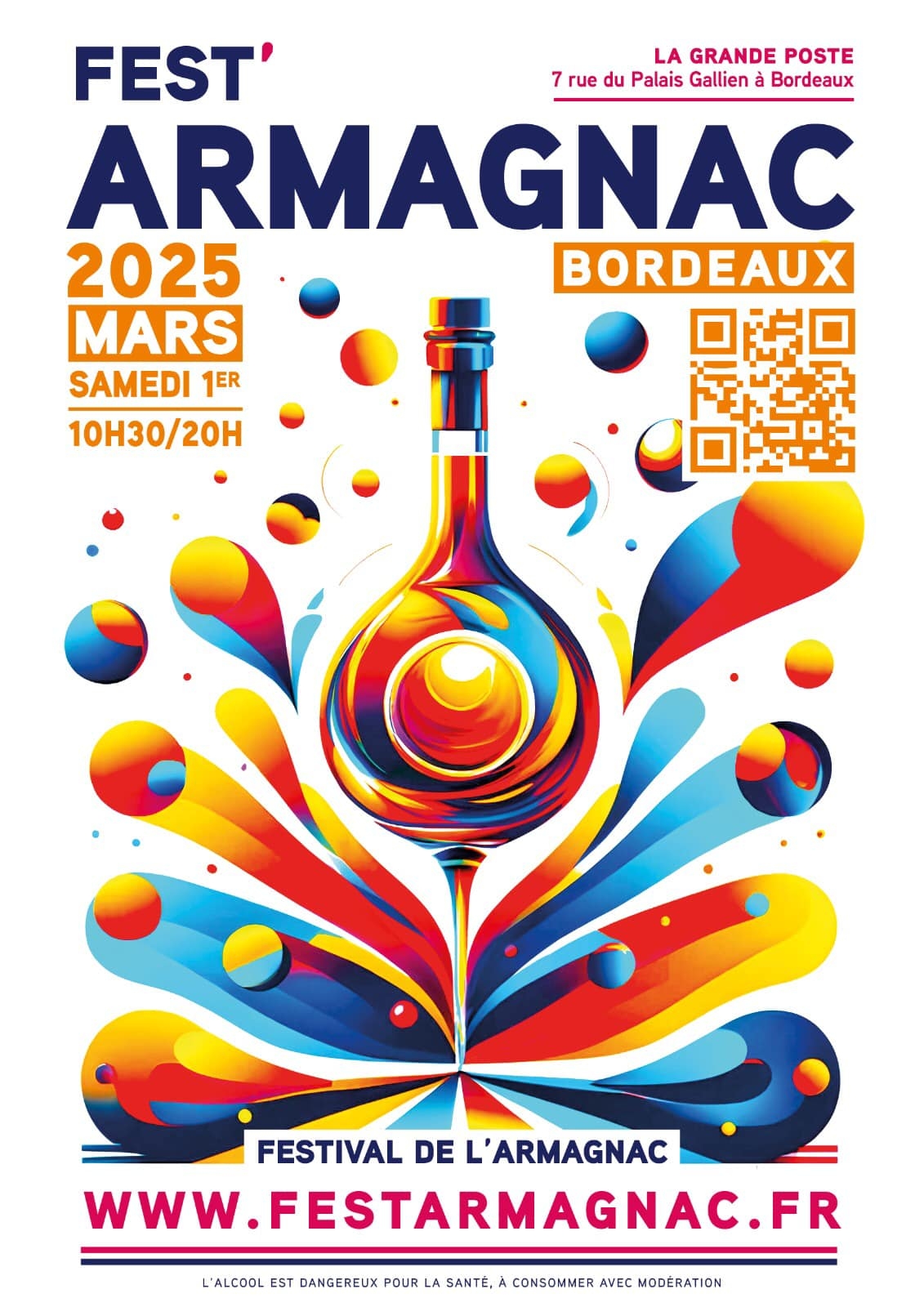
Fest’Armagnac is France’s premier festival dedicated exclusively to Armagnac. Held annually at La Grande Poste in Bordeaux, the 2026 edition will take place on March 7th. The event offers a comprehensive experience with masterclasses on topics like food pairings, Armagnac history, cocktail creation, and cask-strength bottlings. Attendees can also enjoy Gascon cuisine, participate in a tombola, and purchase rare bottles, including exclusive festival editions. https://festarmagnac.fr/
For the first time ever in France, Cognac takes center stage with its very own dedicated festival. The inaugural Cognac Festival will take place on Saturday, November 15, 2025, at the emblematic La Grande Poste in Bordeaux — marking a major moment in the history of this legendary spirit.
This landmark event will unite 36 exhibitors, from iconic houses to indie bottlers and craft distilleries, offering an unprecedented tasting journey through over 200 Cognacs. The day-long experience will feature masterclasses, a mixology workshop, curated food and cocktail pairings, and a boutique for exclusive bottle purchases www.cognacfestival.fr
5) Side-by-Side Comparison Table
Feature Armagnac Cognac
Region Gers, Landes, Lot-et-Garonne Charente, Charente-Maritime, Dordogne,Deux-Sèvres
Terroirs / Crus 3 6 + 1
Main Soil Types Sand, clay, silt Limestone, chalk
Main Grapes Ugni Blanc, Baco, Colombard, Ugni Blanc (main), Folle Blanche,
Folle Blanche Colombard, Montils, Sémillon, others
Distillation Method Single distillation in continuous column still Double distillation in copper pot still (alambic charentais à repasse)
(alambic armagnaçais)
Distillation Season October–January November–March
(La Flamme de l’Armagnac) (Campagne de distillation)
Distillation ABV Min 52% / Max 72.4% Min 67.5% / Max 72.4%
Casking ABV 52%–62% 60%–72% (legal min 63%)
Bottling ABV ≥40% ≥40%
Aging Classifications VS 1Y, VSOP 4Y, XO 10Y VS 2Y, VSOP 4Y, XO/XXO 10Y+, Extra
Paradis / Dame-Jeanne Rare / Yes Yes / Yes
Regulatory Body BNIA BNIC
AOC Status Yes (since 1936) Yes (since 1936)
Jobs Supported Approx. 2,000 Approx. 60,000
Annual Production ~6 million bottles ~165 million bottles
Exports ~1.6 million bottles/Y (58% of total) €3.9 billion/Y
Cultural Ties Deep Gascon traditions, rural identity Napoleon, US cocktail history, luxury
Festival Fest’Armagnac Cognac Festival
Mixology Presence Growing — niche, premium craft cocktails Strong — classic and modern cocktails
Mistelle (Fortified) Floc de Gascogne (AOC) Pineau des Charentes (AOC)
🌟 Why It Matters
Cognac may rule the global stage, but Armagnac whispers with depth — its legacy distilled in copper stills and Gascon soil.
Where one has become the symbol of luxury, the other remains a treasure of tradition, waiting for those curious enough to taste its story.
At TEP, we don’t just celebrate spirits — we chase meaning, terroir, and soul.
And whether it’s a single-estate Cognac or a wild-vintage Armagnac, we always lean toward what’s bold, rooted, and unapologetically alive.
Dive Deeper – Learn More & Explore
- 📘 BNIC – Bureau National Interprofessionnel du Cognac: The official authority for all things Cognac — regulations, terroirs, events, and news.
- 📘 BNIA – Bureau National Interprofessionnel de l’Armagnac: Discover the world of Armagnac, from history to distillation and producer stories.
- 🎉 La Fête du Cognac: A summer celebration of Cognac, music, and local gastronomy held in the town of Cognac.
- 🔥 La Flamme de l’Armagnac: A fiery, festive distillation season across Gascony — tradition, alambics, and terroir in full swing.
- 🎭 Festival Armagnac en Fête (Labastide-d’Armagnac): The heart of Armagnac beats here every autumn — tastings, workshops, and culture.
Published on :
Modified on :