Our themed articles

Chartreuse: The Monks, the Manuscript, and the Bottle That Tells You Its Own Age

Chartreuse: The Monks, the Manuscript, and the Bottle That Tells You Its Own Age

Few spirits carry as much history per centilitre as Chartreuse. A 17th-century manuscript no one could read, a monastic order older than the Magna Carta, an expulsion, a landslide, a Spanish festival that still drinks 15,000 bottles in ten days, and a code on the cap that lets you date any bottle made since 1991. This is the full story — and the collector's cheat sheet that goes with it.

Chartreuse is the only major liqueur in the world still made by the religious order that invented it. Two Carthusian monks — and only two at any given time — know the full recipe. They blend the 130 plants by hand inside the monastery, then send the sealed mixture to a distillery a few kilometres away, where lay staff handle the alcohol but never see the formula. Everything about the liqueur, from its name to its colour to the year on its label, traces back to events that started nearly a thousand years ago.

Here is what every collector should know.


1084: The Order Before the Liqueur

The story doesn't begin with the recipe. It begins with a hermit.

In 1084, a German theologian named Bruno of Cologne — already a respected scholar at the Cathedral School of Reims — left everything behind to settle with six companions in a remote valley in the French Alps, north of Grenoble. The site was called the désert de Chartreuse, a wild stretch of mountain that gave its name to both the order and, eventually, the liqueur. The Carthusians (in French, les Chartreux) became one of the strictest monastic orders in Western Christianity: a life of silence, solitude, prayer, and self-sufficiency.

That last principle matters. Carthusian rule requires monasteries to support themselves through their own labour. Over the centuries this meant woodcutting, metalwork, beekeeping, herbalism — and eventually, a liqueur. The year 1084 is also the number every collector should commit to memory, because it is the key to dating any modern bottle of Chartreuse. We'll come back to it.


1605: The Manuscript

In 1605, at the Carthusian house of Vauvert on the outskirts of Paris, a French nobleman named François-Annibal d'Estrées handed the monks a manuscript. It contained the recipe for an Elixir of Long Life — a blend of more than 130 plants, flowers, roots, barks, and seeds. Where d'Estrées got the document remains unknown to this day. The Carthusians had a reputation as apothecaries, so it was natural enough that he brought it to them.

The recipe was almost too complex to execute. For more than a century the monks struggled with it. It wasn't until 1737, when the manuscript had been transferred to the Grande Chartreuse monastery, that the apothecary Brother Jérôme Maubec finally cracked it. He produced the first stable version of what became the Elixir Végétal de la Grande-Chartreuse — a 69% ABV medicinal tincture still sold today in its distinctive small wooden case.

The recipe was fixed definitively in 1764, and it hasn't meaningfully changed since.

The year 1605 still appears on every bottle of Chartreuse made today. It's the most symbolic date in the entire history of the brand and the reason a special bottling — Liqueur d'Elixir 1605 — was released to commemorate the gift of the manuscript.


From Medicine to Liqueur: Green and Yellow

For most of the 18th century the Elixir was sold as medicine, distributed from mules around villages near the monastery. It got a major boost during the 1832 cholera epidemic, when it was used widely as a remedy. But the monks understood early that a milder version could be a real liqueur in its own right.

In 1840, two new products were born:


  • Green Chartreuse (originally 55% ABV), launched under the name "Liqueur de Santé" — the Health Liqueur. Its intense green colour comes entirely from chlorophyll extracted from the plants. It remains the only major naturally green digestif on the market.
  • Yellow Chartreuse (today 43% ABV, milder and sweeter), nicknamed La Reine des Liqueurs — "The Queen of Liqueurs." The nickname comes directly from Tsar Nicholas II of Russia, who was a devoted drinker of the Yellow at the Imperial Court between roughly 1860 and 1903. His enthusiasm — passed along through the Court's dinner tables across Europe — is what gave the liqueur its royal title, which it has carried ever since. Same plant base as the Green, different alcoholic strength, different maceration, different colour — yellow from saffron.

A note on strength: standard Yellow Chartreuse was historically bottled at 43% until 1973, when it was lowered to 40% for fiscal and tax reasons. In 2021, after a 45-year absence, Chartreuse Diffusion brought the Yellow back to its original 43% globally — explicitly to recover the aromatic balance of the legendary Tarragona and old Voiron bottlings. Every standard Yellow Chartreuse made since the 2021 "Nouveau Tirage" is at 43%.

A third, less famous expression existed too: White Chartreuse, sold between 1860–1880 and again 1886–1903, at 43% and later 37% ABV. The colour was achieved by skipping the final tinting maceration. It never sold as well as the green or yellow and was discontinued at the time of the 1903 expulsion. Today, original White Chartreuse bottles are among the rarest collectibles in the entire category.

The Chartreuse brand was formally registered in 1852. By the late 19th century the liqueur was being exported all the way to the court of Tsar Nicholas II.


The Seven Distilleries

This is one of the most-asked questions among Chartreuse collectors: how many distilleries have there been? The answer is seven, and the seven host cities are today united by the official Pacte d'Amitié Chartreuse® — the Chartreuse Friendship Pact, a charter recognising each commune's historic role in producing the liqueur.

Per the official Chartreuse Diffusion / Fêtes de la Chartreuse records, the seven sites and their precise dates of distillery activity are:

  • Paris — Monastère de Vauvert (1605 – 1737). The original Carthusian apothecary in Paris where Maréchal d'Estrées delivered the manuscript in 1605. More a monastic pharmacy than an industrial distillery, but the place where the elixir was first experimented with for over a century. The monastery itself had existed on the site since 1257 (invited by King Louis IX) and remained until the Revolution destroyed it in 1789.
  • Saint-Pierre-de-Chartreuse — Monastère de la Grande Chartreuse (1737 – 1864). Where Brother Jérôme Maubec finally deciphered the recipe in 1737, and where Chartreuse was produced inside the monastery for the next 127 years.
  • Saint-Laurent-du-Pont — Distillerie de Fourvoirie (1864 – 1903 and 1932 – 1935). The first proper industrial distillery, built in the late 1850s under Dom Jean-Baptiste. The two-period dating reflects the 29-year interruption caused by the 1903 expulsion, with a brief revival between the monks' return in 1932 and the 1935 landslide that destroyed it.
  • Tarragone (Catalonia, Spain) — Distillerie de Tarragone (1904 – 1989). Opened the year after the expulsion, the longest single run in Chartreuse history at 85 years. The "Tarragone" era is now a collecting category in its own right.
  • Marseille — Distillerie du 15 rue de l'Obélisque (1921 – 1932). A smaller French operation opened during the exile to blend Tarragona distillates and circumvent French import restrictions on Spanish-made spirits. The address — 15 rue de l'Obélisque — is still visible in the city today.
  • Voiron — Caves de la Chartreuse (1935 – 2017). Set up in the aftermath of the Fourvoirie landslide, when salvaged barrels were rolled down to Voiron. Produced Chartreuse for 82 years. Still functions today as the ageing cellar (home to the world's longest liqueur cellar, 164 metres) and a tourism site.
  • Entre-Deux-Guiers — Distillerie d'Aiguenoire (2017 to today). The current production site. Built on land the Carthusians had originally owned from 1618 to the Revolution, then bought back. Located at the foot of the Chartreuse massif, very close to the monastery itself. Formally inaugurated on 30 August 2018.
  • Bottles from each of these production sites are collected separately. Fourvoirie bottles (pre-1935) are extremely rare. Tarragona bottles (1904–1989) form their own dedicated collecting category — more on this below.


    1903: The Expulsion

    The early 20th century brought one of the most dramatic episodes in the history of any spirit.

    France in the 1890s and early 1900s was in the grip of aggressive anticlericalism. The Waldeck-Rousseau law of 1 July 1901, and especially its Article 13, required all religious congregations to obtain authorisation from the state to operate. The Carthusians were refused. On 29 April 1903, French soldiers arrived at the Grande Chartreuse to forcibly expel the monks. Several thousand local people protested. Some of the army officers ordered to carry out the operation refused — a captain and a commander of the French Dragoons resigned, with the latter calling it "a bandit's job."

    The monks fled to Italy first, then to Spain, taking the recipe with them. The Fourvoirie distillery and the Chartreuse brand were nationalised and sold to a private French company — the Compagnie Fermière de la Grande Chartreuse — which tried to produce its own "Chartreuse" using staff who didn't have the recipe. The result was so inferior that it was mockingly nicknamed "liquidatreuse". The company went bankrupt in 1929.

    In a remarkable gesture, a group of friends and merchants in Voiron bought up the worthless shares at rock-bottom prices and gifted them to the exiled monks. The Carthusians had their brand back.


    The Tarragona Story (1903–1989)

    The Spanish chapter is the longest single-location run in Chartreuse history — 86 years.

    After the expulsion, the father distillers opened a new facility in Tarragona, Catalonia. Within a year they were back on the world market. Because they had lost the right to call the liqueur "Chartreuse" in France, the bottles carried an additional label reading Liqueur fabriquée à Tarragone par les Pères Chartreux ("Liqueur made in Tarragona by the Carthusian Fathers"). In France, the bottles became known simply as "Tarragone." If you wanted the real thing during this period, you asked for "une Tarragone" and the bartender knew exactly what you meant.

    Tarragona continued to produce even after the monks returned to France in 1929 and resumed distillation at Fourvoirie. The two sites ran in parallel for most of the 20th century. The civil war years were difficult — the Tarragona distillery was bombed in 1938 — but production survived.

    1989 was the end. Sales had declined, two parallel distilleries could no longer be justified, and the operation was consolidated back in France. The Tarragona buildings were sealed off; the ageing warehouse and bottling hall were later converted into a language school. The stills remain inside, intact but inactive.

    Tarragona bottles are now one of the most desirable categories in the entire Chartreuse collecting world. Within Tarragona, several sub-eras and special bottlings are worth knowing:


    • La Fabiola — a special Green Chartreuse produced in Tarragona between 1966 and 1973, in honour of Queen Fabiola of Belgium, the Spanish-born aristocrat who had married King Baudouin in 1960. Her popularity in Catalonia made the bottling a natural commercial tribute from the Tarragona distillery.
    • The "double-label" period of 1930–1941, when bottles carried both "Chartreuse" and "Tarragone" markings during the brand recovery years.
    • Various cap colours, seal types, and export sub-labels (notably the Export Argentine and Licor Cumbre bottlings for the South American market).


    1935: The Landslide

    The monks regained Fourvoirie in 1929 and resumed distillation in 1932. The reprieve lasted three years.

    On the night of 14 November 1935, a massive landslide came down the mountainside and destroyed the Fourvoirie distillery. Buildings were ruined; part of the stock washed into the river below. The French army was called in to help recover what could be saved. Crucially, the oak barrels and the large copper stills survived in usable condition.

    What happened next is one of those quietly remarkable details: the French government — the same state that had expelled the monks 32 years earlier — sent army engineers to help relocate the operation. The salvaged barrels were rolled down to Voiron, a town some 15 km away where the Carthusians already owned a small warehouse and an ageing cellar. The famous foudres in the Voiron cellar today still sit on their sides because they had to be tipped to fit through the doorways in 1935. They have not moved since.

    Production resumed in Voiron in 1936. The monks were officially allowed to return to the Grande Chartreuse monastery in 1940, by a decree of Georges Mandel. The expulsion order was formally lifted after the Liberation in 1945.


    Santa Tecla and La Mamadeta: The Spanish Legacy That Refused to Die

    When Tarragona closed in 1989, the city did not let go.

    For more than 85 years Chartreuse had been a Tarragonan product as much as a French one. The Carthusian distillery was woven into the fabric of the city, and the liqueur became the official drink of the local patron saint's festival: Santa Tecla, held every year from around 13–23 September, with the saint's feast day on the 23rd.

    The festival drink is the Mamadeta — a slushy of equal parts Green Chartreuse, Yellow Chartreuse, and lemon granita. (Catalan speakers will recognise the literal meaning of the word; the Tarragonans take it in stride.) During the ten days of Santa Tecla, an estimated 15,000 bottles of Chartreuse are consumed across the old town. The festival features the city's famous castells (human towers), correfocs (fire runs), and the Baixada de l'Àliga procession, with Chartreuse flowing through it all in plastic cups and branded squeeze bottles.

    Despite production having moved entirely to France, the bond is maintained. The president of Chartreuse Diffusion travels from Voiron to Tarragona every year to attend a special dinner hosted by the mayor. And — most importantly for collectors — Chartreuse releases dedicated Tarragona bottlings every year for the festival:


    • Santa Tecla edition (since 2000) — both Green and Yellow versions, each carrying a unique illustration on the label tied to that year's festival emblem. Note: although Tarragona stopped producing in 1989, the annual labelled Santa Tecla editions only began with the 2000 vintage. Earlier festival bottles exist but without the now-iconic year-specific artwork.
    • The Tau (since 2017) — the Chartreuse Épiscopale described above. A 70% Yellow / 30% Green blend at 44% ABV, dressed in the colours of the city and bearing the Tau cross. Effectively a pre-bottled Mamadeta. Production has typically run around 5,000–8,000 bottles per edition, sold exclusively in the Tarragona region.


    V.E.P., Foudre 147, and the Special Cuvées

    Chartreuse is unusual among liqueurs in that it continues to evolve in the bottle. Glass-aged bottles change measurably over decades — collectors describe Yellow Chartreuse as ageing into "liquid space honey," and old Greens taking on rich baked-spice and dark-fruit notes the modern versions don't have.

    The official extra-aged line is the V.E.P.Vieillissement Exceptionnellement Prolongé (Exceptionally Prolonged Ageing). It was launched in 1963. Standard Chartreuse is aged 3 to 5 years in oak; V.E.P. is aged anywhere from 11 to 20 years in smaller demi-muid casks. Each V.E.P. bottle is numbered. There is no age statement printed — but you can derive the bottling year using the cap code (see below).

    Other notable specials (the date shown is when each cuvée was first introduced — most are still released regularly today):


    • 9th Centenary (since 1984) — first released to mark 900 years of the Carthusian Order, re-released periodically
    • Liqueur d'Elixir 1605 (since 2005) — created for the 400th anniversary of the manuscript
    • MOF Yellow (since 2007) — developed in partnership with the Meilleurs Ouvriers de France Sommeliers
    • La Reine des Liqueurs (since 2010) — Yellow at 43%, recreating the 19th-century recipe in honour of the Tsar Nicholas II nickname; produced in small numbered batches
    • The Tau (since 2017) — a Chartreuse Épiscopale at 44% ABV, blending 70% Yellow and 30% Green, sold only in the region of Tarragona. The name refers to the Tau cross, the T-shaped symbol of the archbishopric of Tarragona. (Épiscopale — literally "of a bishop" — is the historic Catalan term for any cocktail or blend of Green and Yellow Chartreuse. The name dates back to the 1970s in Tarragona, when visitors to the distillery were served an "Episcopal" of Chartreuse and cava — Catalan sparkling wine — referencing the dual-colour vestments of a bishop. Today the term is used by Chartreuse Diffusion for any official pre-blended Yellow + Green cuvée.)
    • Une Chartreuse (since 2015) — a perpetual-reserve cuvée drawing on the historic Voiron stocks, around 240 bottles released each year
    • Foudre 147 (since 2019) — the only cuvée still aged at Voiron, drawn from a single historic cask, sold exclusively at the Voiron boutique
    • Santa Tecla (since 2000)
    We'll publish a dedicated companion article cataloguing every Chartreuse release — Centenary, MOF, Tau, Reine des Liqueurs, Une Chartreuse, Foudre 147, Santa Tecla year by year — with bottle photos, ABVs, run sizes, and label variations.
    The Modern Era: Chartreuse Diffusion (1970) and the Return to Paris (2023)

    Two dates define the modern chapter.

    In 1970, the Carthusian Order created Chartreuse Diffusion, a separate company tasked with everything the monks didn't want to handle themselves: marketing, packaging, bottling logistics, distillery operations management, tourism, and sales. The monks kept the recipe and the plant blending — full stop. Everything else became Chartreuse Diffusion's job. Today the company employs around 80 people, generates roughly €30 million in annual revenue (about half of it from exports), and is led by Emmanuel Delafon. It is the entity that decided to cap production at 1.6 million bottles per year in 2019, and it operates every commercial site associated with the brand.

    The second date is 28 November 2023. On that day, Chartreuse Diffusion inaugurated Chartreuse Paris-Vauvert, the brand's first ever Paris location and only its second cultural site outside the Voiron cellars. The address is no accident: 128 boulevard Saint-Germain, in the 6th arrondissement (Métro Odéon), a few minutes' walk from the Luxembourg Gardens — exactly where the Chartreuse de Vauvert monastery once stood. The Carthusians had lived on that ground from 1257, when they were invited to Paris by King Louis IX, until the French Revolution destroyed the monastery. It is the very site where Maréchal d'Estrées handed over the 1605 manuscript. The trees you see today in the Luxembourg Gardens are descendants of the monks' original nursery.

    The new venue spans two floors of 125 m² each (250 m² in total) and is closer to a museum-bar hybrid than a typical boutique. What you find inside:


    • Museum spaces dedicated to the Carthusians' 500-year history in Paris, the development of the Elixir Végétal, and the monastic tradition of herbalism
    • Original archives from the Chartreuse Order and the Vauvert monastery, including documents from the 17th and 18th centuries
    • A historic Carthusian still that was used at the third distillery, Fourvoirie, before its destruction in 1935
    • A collection of antique bottles and elixir flasks drawn from across the brand's history
    • A boutique selling Green, Yellow, Elixir Végétal, Liqueur d'Elixir 1605, the MOF Sommeliers Yellow, and the 9th Centenary blend — limited to 3 bottles per customer (Paris is on the same allocation system as every other authorised shop since the 2019 production cap)
    • A herbal tea range (tisanes) developed by Chartreuse Diffusion as a deliberate return to the monks' apothecary roots — blends for sleep, digestion, respiratory health, and muscular relaxation
    • A bar area styled after early-1900s Paris, where the standard Chartreuse range can be tasted by the glass (closed Sundays)
    • A hidden speakeasy on the lower level, available by reservation for private events and workshops

    Bookable activities at the Paris site include:


    • Guided walk through the Luxembourg Gardens retracing the 500 years of Carthusian history in Paris from 1257 to the Revolution, ending with a tasting back at the speakeasy (≈2 hours, around €19)
    • Discovery tasting — a one-hour history immersion in the speakeasy paired with a guided tasting (around €45)
    • Vertical tasting workshops — comparing different vintages and expressions of Chartreuse across the decades (≈2 hours, around €45)
    • Tisane-blending workshops — hands-on sessions learning to assemble herbal blends from the monks' botanical tradition (around €95, weekends only)

    All tours and workshops are bilingual (French / English). The boutique is open daily from 10:00 to 19:00, and on Sundays from 12:30 to 18:00 (the bar is closed on Sundays). Reservations for the experiences are handled via paris.vauvert@chartreuse.fr.

    For collectors and serious enthusiasts, Paris-Vauvert is now the second pilgrimage destination after the Voiron cellars — and historically the more meaningful of the two, because it sits on the ground where the entire Chartreuse story began in 1605.


    Les Fêtes de la Chartreuse: An Annual Festival Across Four Communes

    If Santa Tecla is Chartreuse's adoptive Spanish festival, Les Fêtes de la Chartreuse is its French equivalent — and a much younger tradition. The first edition was held in 2015, and the festival has run annually ever since, taking place every May around the symbolic date of the 16th, 16.05 is the official Chartreuse Day. The festival spans four to five days each year. The 11th edition runs from 13 to 17 May 2026.

    The festival exists to celebrate what locals call the trilogie Chartreuse — "the Chartreuse trilogy":


  • The Chartreuse massif itself — the protected natural area between Grenoble, Chambéry, and Voiron
  • The Carthusian Order, founded in the massif by Saint Bruno in 1084
  • The Chartreuse liqueurs, made by the monks from 130 plants since the 18th century
  • Unlike Santa Tecla, which centres on a single city, Les Fêtes de la Chartreuse spreads across four host communes every year, all signatories of the Pacte d'Amitié Chartreuse®:


    • Voiron — home of the Caves de la Chartreuse, where the festival's main events take place
    • Saint-Pierre-de-Chartreuse — village of the monastery itself
    • Saint-Laurent-du-Pont — site of the old Fourvoirie distillery
    • Entre-Deux-Guiers — current home of the Aiguenoire distillery

    The festival programme always includes a clin d'œil — a symbolic nod — to the three other Pacte d'Amitié signatory cities that once hosted Chartreuse distilleries but lie outside the massif: Paris, Marseille, and Tarragone.


    Seven Stars to Seal a Friendship

    There's a beautiful symbolic detail attached to the Pacte d'Amitié. Seven stars have been forged by local artisans, one for each of the seven host cities. They are made in Corten steel — an alloy chosen for two reasons: it recalls the metal of the stills used for distillation, and it nods to the historic forge work of the Carthusian monks (the order had a long metallurgical tradition before becoming distillers).

    The seven stars also carry a deeper resonance: they recall the founding of the order in 1084, when, according to tradition, Saint Hugues, Bishop of Grenoble, dreamed of seven stars guiding Saint Bruno and his six companions to the désert de Chartreuse — the wild valley where they would settle and found the order. Seven stars, seven monks, seven distilleries, seven cities. During the festival, the seven stars converge on a common plinth in Voiron, representing the unity of the Pacte.


    The Festival Programme

    The programme typically includes:


    • A grand defilé (parade) departing from the Caves de la Chartreuse and ending in the Voiron town centre
    • A massive open-air banquet populaire seating up to 3,500 guests
    • A son-et-lumière pyrotechnic show projected onto the façade of Saint-Bruno church
    • A cocktail competition in Entre-Deux-Guiers, where a Chartreuse-based winner is unveiled on the Sunday
    • Guided tours of the Caves de la Chartreuse at reduced rates, with the bar exceptionally open all week
    • Conferences, exhibitions, and tastings on the Order, the massif, and the plants
    • Visits to the old Fourvoirie distillery site at Saint-Laurent-du-Pont (now in ruins, but accessible during the festival)


    Three Open Competitions

    A delightful detail of the festival is that three of its core elements are decided by public competition:


    • Concours d'affiche (poster competition) — anyone can submit a design for the official festival poster. The jury, drawn from Chartreuse Diffusion, the participating mayors, and the local cultural community, selects the winner. The 10th edition (2025) had three competing designs in the final round. Each year's poster becomes a collectible in its own right, tied to that year's theme (2025: le végétal — the botanical world).
    • Concours de vitrines (shop-window competition) — Voiron shopkeepers compete to decorate their storefronts in Chartreuse colours, with prizes awarded during the parade.
    • Concours photo (photo competition) — visitors are invited to submit photographs from the festival itself, with the best images selected for the following year's communications.


    Festival Merchandise: The Annual Bottle and the Raidlight Foulard

    Each year, Chartreuse Diffusion releases two festival-only items that have become collectibles in their own right:


    • The Fêtes de la Chartreuse bottle — a dedicated bottling (Green or Yellow) with a unique label tied to that year's festival edition, sold primarily at the Voiron Caves and the festival venues. A French parallel to the Tarragona Santa Tecla editions, with the early editions (2015 onwards) becoming increasingly scarce on the secondary market.
    • The Chartreuse foulard — an annual scarf made in Raidlight technical fabric (Raidlight is a French trail-running brand). The choice of Raidlight reflects the regional identity — the brand is based in Saint-Pierre-de-Chartreuse — and gives the foulard a useful, sporty character rather than a purely decorative one. Each year's foulard carries a distinct design.

    For collectors, securing both the bottle and the foulard in matching years is now part of the annual ritual.


    A Liqueur That Named a Colour

    Here is a piece of trivia that holds up under scrutiny: Chartreuse is the only alcoholic beverage in the world to have given its name to a colour.

    Think about it for a moment. Orange came from the fruit. Magenta from a battle. Burgundy from a wine region — not a wine. Champagne is sometimes called a colour but informally, and never with the linguistic standing of a real colour term. Cognac and bourbon are talked about as leather and shoe shades, but neither has been formally entered into the language as a colour. Chartreuse, on the other hand, is in every dictionary, every Pantone book, every paint catalogue, every fashion glossary.

    The word entered the English language as a colour term in 1884, and the French usage is even older. The shade in question — a sharp, glowing yellow-green sitting halfway between lime and electric lemon — comes directly from the chlorophyll-derived hue of the Green Chartreuse liqueur. Painters had been using it for centuries (Fragonard, Van Gogh, the Impressionists all reached for it), but it was only after the liqueur's commercial success in the 19th century that the colour got its name.

    There's a sub-shade too: chartreuse yellow, originally named simply "chartreuse" in 1892 after the Yellow version of the liqueur. Since 1987, it has been formally renamed "chartreuse yellow" to avoid confusion with the green chartreuse.

    So when you order a Last Word at a bar in 2026, the colour of the cocktail in your glass is named after the liqueur that made it possible — a small piece of linguistic history that no other spirit in the world can claim.


    How to Date Any Bottle of Chartreuse: The 1084 Trick

    This is the part collectors come for, and it is genuinely simple.

    Since 1991, every bottle of Chartreuse has carried a six-digit lot code on the thin gold band at the top of the bottle (just below the seal). The code is preceded by the letter L, like this: L940032.

    To decode it:


  • Take the first three digits. In our example, that's 940.
  • Add 1084. (Yes — the year Saint Bruno founded the Carthusian order. The bottling year is calculated relative to the order's founding.)
  • 940 + 1084 = 2024. That's the year the bottle was sealed.
  • The last three digits are the day of the year (1–365). So 032 means the 32nd day of 2024, which is 1 February.
  • A bottle marked L940032 was therefore sealed on 1 February 2024.

    This works for every bottle produced after 1991. For older bottles, you can't get a precise date, but you can narrow the era by looking at the importer listed on the back label.


    United States

    The US importer history is the most thoroughly documented of any market, largely thanks to Tim Masters at Frederick Wildman & Sons, who has compiled the timeline below:

    ImporterApproximate PeriodBatjer & Co.c. 1895 – ProhibitionShently1933 – c. 1940sSchieffelin & Sonsc. 1940s – 1969Sussex (James C. Sussex Ltd)1969 – 198121 Brands1981 – 1990Frederick Wildman & Sons1990 – present

    A US-only detail worth knowing: silver caps were switched to black in 1980. Any US bottle with a silver cap is therefore pre-1980, regardless of importer.


    France (domestic)

    France has its own internal lineage tied to the corporate history of the brand itself rather than a third-party importer:

    OperatorPeriodPères Chartreux (direct, L. Garnier signature)1840 – 1903Compagnie Fermière de la Grande Chartreuse (counterfeit "liquidatreuse")1903 – 1929Carthusians as "Tarragona" / Marseille blends1921 – 1929 (parallel)Compagnie Française de la Grande Chartreuse1929 – 1970Chartreuse Diffusion1970 – present


    Italy

    Italian collectors will repeatedly come across one name: P. Soffiantino & Co., a historic Genoa-based importer. Soffiantino-imported Chartreuse bottles are dated from at least the mid-1970s through the 1990s, and the company also imported other premium spirits of the era (Bowmore, Appleton). A Soffiantino back label on an old bottle is a strong indicator of Italian-market provenance — and the bottles tend to surface frequently at Italian auctions.


    United Kingdom

    UK distribution is currently handled by Cask Liquid Marketing (Ipsosolo Ltd). Older UK distributor history is less well documented in public sources than the US lineage — bottle hunters in Britain typically have to rely on the cap code (post-1991), production site, label design, and any UK retailer overstickers to date a bottle.


    Spain and South America

    Spain didn't need an importer during the Tarragona years — production was domestic from 1903 to 1989. Spanish-market bottles from that era often carry different labels, festival editions (Santa Tecla), or local names like "El Licor Cumbre" and "La Fabiola." A significant portion of Tarragona's output was also exported to Argentina and Brazil, with specific "Export Argentine" markings on the back labels — these bottles still occasionally surface in South American estate sales and are sought after by collectors precisely because they rarely made it back to Europe.


    Germany and other export markets

    Various 20th-century bottles also exist with German-language back labels marked "Export," confirming distribution into German-speaking markets. Documentation is sparse, but the bottles themselves are physical evidence of the export network.


    Putting it together

    Combine the importer name with the production location on the label (Fourvoirie, Tarragona, Marseille, Voiron, Aiguenoire), the alcoholic strength (Yellow was lowered from 86 proof / 43% to 80 proof / 40% in 1972 for the US market — note that the modern Yellow is back at 43%), and the cap colour, and you can usually pin a pre-1991 bottle to within a few years even without a lot code.


    Why Chartreuse Became a Collectors' Spirit

    Three things came together to push Chartreuse from an obscure herbal digestif into one of the most collectable spirits on the market.

    The first is the cocktail revival of the 2000s. Drinks like The Last Word (gin, maraschino, lime, Green Chartreuse, equal parts) and the Bijou put the liqueur back behind every serious bar in the world. Bartenders started hunting vintage bottles to taste the difference between modern and old.

    The second is the 2019 production cap. The monks, citing environmental concerns and their commitment to monastic life, decided to limit annual production to roughly 1.6 million bottles. Global demand at that point was several multiples of supply. Suddenly Chartreuse — never a cheap liqueur, but always available — became scarce. By 2022, bars in major US cities reported being completely unable to source it. Prices on the secondary market climbed sharply.

    The third is the in-bottle ageing. Unlike most distilled spirits, which are essentially stable in glass, Chartreuse keeps evolving. A bottle of Green Chartreuse from 1985 is not the same liquid as a bottle from 2025, even if both were filled at the same proof. Collectors who appreciate this — and the importers, like Tim Masters at Frederick Wildman, who have built tasting libraries spanning fifty years — treat Chartreuse closer to fine wine than to a typical spirit.


    A Quick Buyer's Checklist

    If you're hunting Chartreuse — at auction, in a dusty corner of a wine shop, in a relative's cabinet — here's what to look at:


    • Cap code starting with L → modern bottle (post-1991), date it precisely
    • No cap code → pre-1991, identify by importer and production site
    • "Fabriquée à Tarragone" on the label → Tarragona bottling (1903–1989), automatically of interest
    • "Voiron" on the label, no Tarragona reference → 1936–2017 French production
    • "Aiguenoire" → 2018 or later
    • Silver cap → signals an older bottling, often pre-1980s; an industry tip for "bottle dusting"
    • Santa Tecla back label → annual limited edition, value depends on year and condition
    • Numbered V.E.P. bottle → date via the cap code; older V.E.P.s with low numbers are especially prized
    • White Chartreuse → if genuine and verifiable (pre-1903), one of the rarest in the category


    Closing Note

    There is no other spirit in the world quite like Chartreuse. The recipe predates most modern countries. The producer is a monastery older than the Tower of London. The bottle on your shelf was sealed on a specific day you can calculate, and the liqueur inside is still changing as you read this.

    Whether you drink it neat after dinner, stir it into a Last Word, or set it aside in a dark cupboard to come back to in a decade, you are participating in a chain that runs from a manuscript handed to monks in Paris in 1605, through a forced exile, a landslide, a Spanish festival, and a recipe known to exactly two living people — and back to 1084, a year so old it's now hiding on the cap of your bottle.


    To Discover

    For more on the liqueur, the order, the cellars, the Paris site, and bookable experiences:

    chartreuse.fr

    For the annual French festival — programme, poster competition, history of the Pacte d'Amitié, and the seven stars:

    fetesdelachartreuse.fr

    Published on :

    Modified on :
    #Eau de vie

    #Liqueur

    #Chartreuse

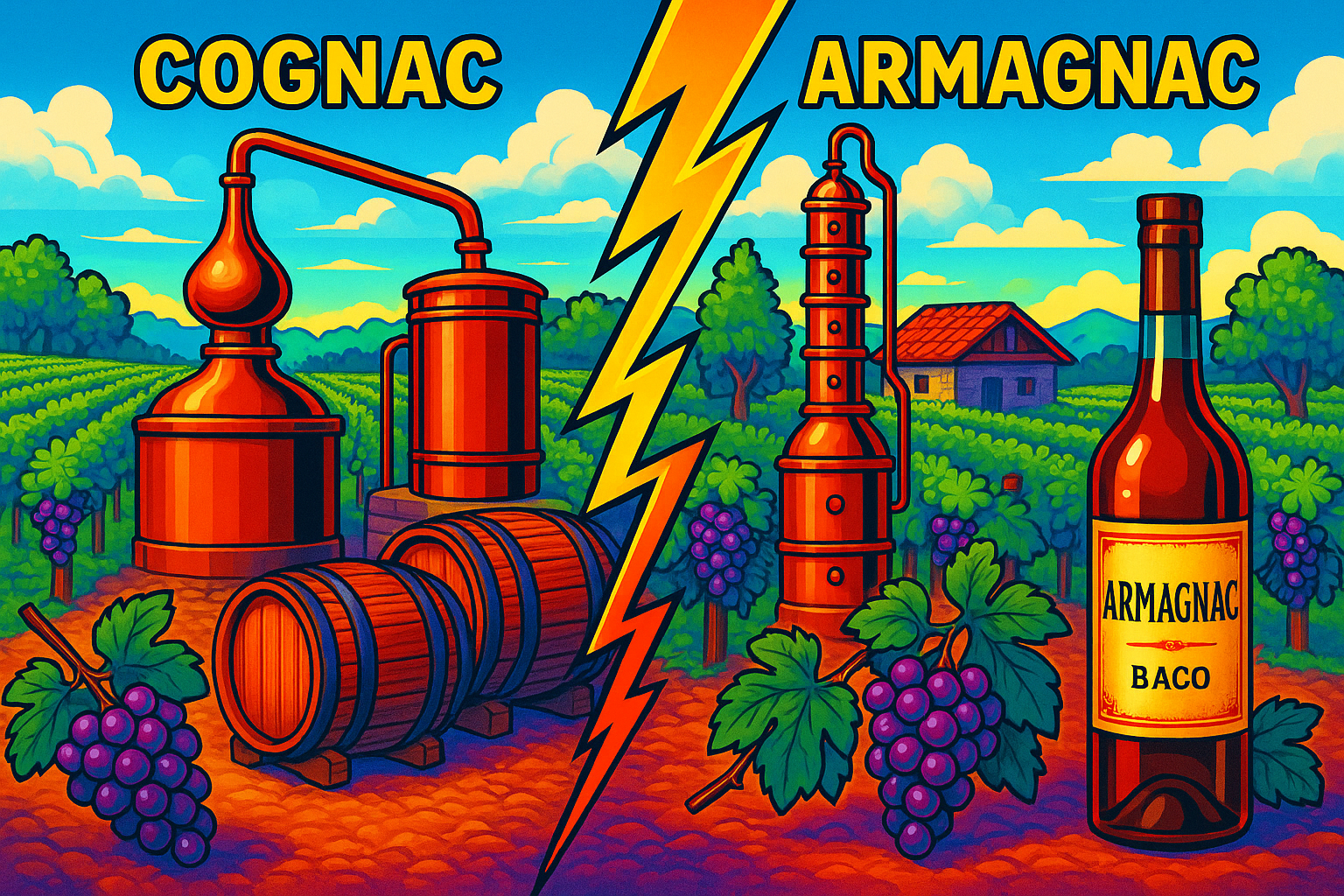
    Cognac vs. Armagnac — Same Grapes, Different Souls

    Cognac vs. Armagnac — Same Grapes, Different Souls

    Cognac gets the spotlight. Armagnac keeps the soul.

    Both are iconic French brandies — but the comparison stops there. If Cognac is the nowadays polished aristocrat born into global fame, Armagnac is the Gascon poet with muddy boots and roots sunk deep into the land. Still, beyond the major houses, Cognac remains a landscape of family-owned domaines and centuries-old savoir-faire.


    1) Armagnac: The Gutsy Gascon Spirit


    Origin & Terroirs

    Long before Cognac conquered the world stage, Armagnac was already flowing in the heart of Gascony. Officially mentioned in a 1310 manuscript by Maître Vital Dufour, who praised its 40 medicinal virtues, Armagnac is France’s oldest recorded eau-de-vie.

    Still today, Armagnac is deeply artisanal, produced by small growers and family-run estates who value craft over scale. It is protected by an AOC (Appellation d’Origine Contrôlée) status since 1936, which guarantees origin, traditional methods, and strict production guidelines.


    Armagnac hails from Gascony, covering Gers (32), Landes (40), and Lot-et-Garonne (47). The AOC is divided into three official terroirs:


    • Bas-Armagnac – sandy soils, finesse, and fruit
    • Ténarèze – clay-limestone, known for power and structure
    • Haut-Armagnac – chalky, rare, scattered vineyards


    Grapes & Distillation

    Ten authorized grapes, with Ugni Blanc, Baco 22A, Folle Blanche, and Colombard most common. Armagnac is distilled once using a continuous column still (alambic armagnaçais), retaining more congeners and giving a fuller, earthier profile.


    ABV Regulations

    For Armagnac, distillation must occur between 52% and 72.4% ABV, depending on the desired style and the still used. Once distilled, the spirit is typically reduced and casked at a strength between 52% and 62% ABV. Before bottling, it is brought down to a minimum legal strength of 40% ABV, as required by French and EU regulations.


    Distillation Season – La Flamme de l’Armagnac

    Running from October to January 31st, the distillation period is not only regulated but also celebrated. Known as La Flamme de l’Armagnac, this season features public tastings, rural feasts, and the unmistakable scent of brandy flowing through copper stills.


    Aging & Compte d’Âge

    Armagnac is aged in Gascon oak, yielding a spicy, bold character. It uses a similar age classification system:


    • VS: 1Y minimum
    • VSOP: 4Y
    • XO / Hors d’âge: 10Y+
    • Vintage bottlings: common and highly valued


    Mixology & Culture

    While often overlooked in classic cocktail books, Armagnac is a bartender's secret weapon — rich, soulful, and deeply complex. It's ideal for Old Fashioneds, Sours, or neat sipping. Though exports are modest (approx. 1.6 million bottles in 2018, with 58% going abroad), interest is growing in the U.S., China, Russia, and the UK, especially in craft and natural spirits circles.


    Floc de Gascogne

    Armagnac’s fortified wine cousin, Floc de Gascogne, is a mistelle made by blending grape must with young Armagnac. Often enjoyed as an aperitif, it is light, floral, and protected by its own AOC since 1990.


    2) Cognac: The Refined Spirit of Charente


    Cognac is more than a luxury spirit — it’s a symbol of French diplomacy, legacy, and craftsmanship.

    Its roots stretch back to the 16th–17th centuries, when Dutch and English merchants encouraged Charentais winemakers to distill their wines for preservation. This practical export solution evolved into a refined art.

    Napoleon Bonaparte had a known appreciation for Cognac and is said to have had barrels sent with him into exile — cementing the spirit's symbolic link to French imperial identity.

    Cognac may be the more famous sibling, but its success is no accident. It is built on centuries of refinement, branding, and global positioning — with AOC status since 1936 and a strong governing body, the BNIC (Bureau National Interprofessionnel du Cognac).

    Cognac is revered for its elegance, consistency, and global export strength — it is France’s largest spirits export by value.


    Origin & Crus

    Produced in Charente (16), Charente-Maritime (17), and parts of Dordogne (24) and Deux-Sèvres (79). The AOC defines six + one crus. Soils are chalky and limestone-rich, similar to Champagne, which gives the spirit its hallmark finesse and floral clarity:


    • Grande Champagne: Known for producing eaux-de-vie with exceptional aging potential and floral notes
    • Petite Champagne: Offers similar qualities to Grande Champagne
    • Borderies: The smallest cru, known for its nutty and violet aromas
    • Fins Bois: Produces round and supple eaux-de-vie that age relatively quickly
    • Bons Bois and Bois Ordinaires: Yield more rustic and fast-aging spirits, often used in blends
    • Fine Champagne – blend of Grande & Petite, with at least 51% Grande Champagne


    Grapes

    The primary grape used in Cognac production is Ugni Blanc, also known as Trebbiano Toscano, prized for its high acidity and low sugar content, which are ideal for distillation. Other permitted varieties include Folle Blanche, Colombard, Montils, Sémillon, and Folignan, each contributing unique aromatic profiles to the final spirit


    Distillation Process

    Cognac undergoes a double distillation process in traditional copper pot stills, known as "alambic charentais." The first distillation yields a liquid called "brouillis," which is then distilled a second time to produce the "bonne chauffe," resulting in a clear eau-de-vie with a maximum alcohol content of 72.4% ABV.


    ABV Regulations

    For Cognac, distillation is allowed up to a maximum of 72.4% ABV, which ensures the preservation of delicate aromatic compounds. The eaux-de-vie are generally casked at strengths ranging from 60% to 72% ABV, depending on the house's practice and barrel type. As with Armagnac, Cognac must be bottled at no less than 40% ABV.


    Distillation Season – Campagne de Distillation

    From November 1 to March 31, tightly regulated by the BNIC (Bureau National Interprofessionnel du Cognac) to maintain standards across vintages and houses.


    Aging & Compte d’Âge

    Aged in Limousin or Tronçais oak, Cognac follows a structured, transparent system:


    • VS: 2Y (Compte 2)
    • 3Y: Cuvée Supérieure, Qualité Supérieure
    • VSOP: 4Y (Compte 4)
    • 5Y: Vieille Réserve, Réserve Rare, Réserve Royale
    • 6Y: Napoléon, Très Vieille Réserve, Très Vieux, Excellence, Héritage, Suprême (unofficial but widespread)
    • XO: 10Y (Compte 10)
    • XXO: 14Y (Compte 14)


    Mixology & Cultural Identity

    Cognac is a cornerstone of French luxury and a global cocktail icon. Bartenders value its depth in classics and new creations alike. In the United States, Cognac became a cornerstone of early American mixology. From the Sazerac and Brandy Crusta to the Sidecar, it left an indelible mark on bar culture that continues today.


    Angel’s Share, Dame-Jeanne & Paradis

    As it ages, these spirits lose up to 2-3% per year to evaporation — the “part des anges”.

    Over time, evaporation perfumes the air and leaves blackened walls from natural microbial activity (baudoinia fungus) on cellar walls.


    Storage Tradition – Dame-Jeanne

    For especially rare spirits, producers may withdrawn from barrels and store to dame-jeannes (large glass demijohns) to stop aging and preserve its peak character.


    The Paradis (term mostly used in Cognac) is where houses age their oldest eaux-de-vie — often for decades — in calm, humid cellars in Dame-Jeanne. Hence the reference to what’s the best.


    Economic Significance

    Cognac is a major contributor to France's export economy, with significant markets in the United States, China, and the United Kingdom. The industry supports thousands of jobs and encompasses numerous Cognac houses and winegrowers .


    Pineau des Charentes

    Like Floc de Gascogne, Pineau des Charentes is a fortified wine (mistelle) made by blending grape must with fresh Cognac eau-de-vie. It was born allegedly by accident, and now stands as an AOC-protected regional treasure enjoyed as an aperitif or in cocktails.


    3) The Mystery of Rancio: Time’s Signature in the Cellar


    One of the most prized and elusive notes in long-aged Cognac and Armagnac is rancio — a term that doesn’t translate easily, but every seasoned taster knows when they taste it.

    Rancio refers to a complex, oxidative aroma and flavor that develops after long barrel aging, typically 15 to 20+ years. It is not a flaw, but a desirable evolution — often described with notes of dried fruit, walnut, mushroom, forest floor, old wood, leather, and even umami.

    This character emerges from a delicate combination of:


    • Oxidative reactions in old, semi-porous oak barrels
    • Maillard reactions during long maturation
    • The interaction between spirit, wood, and humid cellar conditions (chais humides)


    Rancio is a sign not just of age, but of patience and respect for time. It’s what separates a merely old spirit from a truly transcendent one.


    4) Dedicated Festival and show


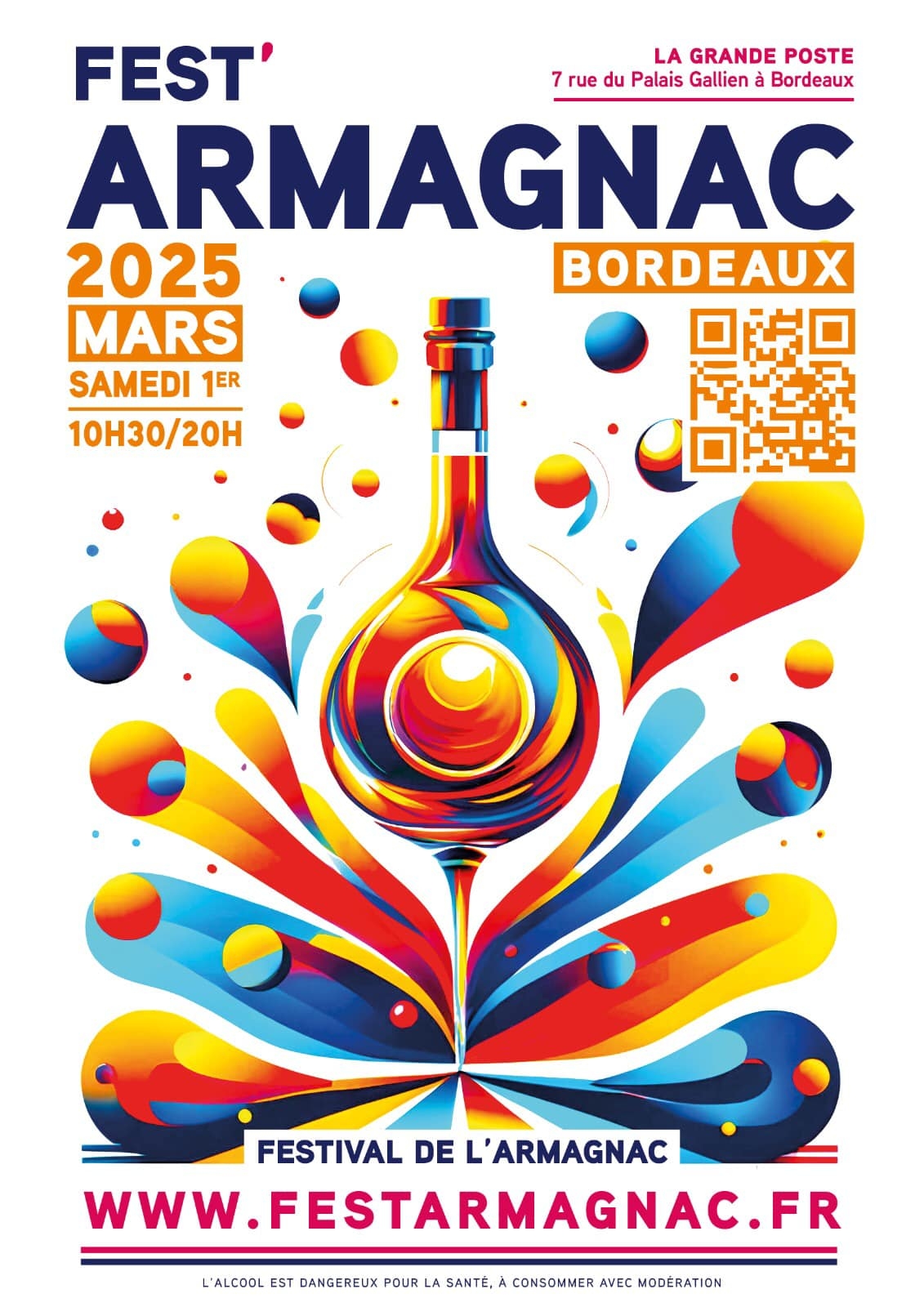
    Fest’Armagnac is France’s premier festival dedicated exclusively to Armagnac. Held annually at La Grande Poste in Bordeaux, the 2026 edition will take place on March 7th. The event offers a comprehensive experience with masterclasses on topics like food pairings, Armagnac history, cocktail creation, and cask-strength bottlings. Attendees can also enjoy Gascon cuisine, participate in a tombola, and purchase rare bottles, including exclusive festival editions. https://festarmagnac.fr/


    For the first time ever in France, Cognac takes center stage with its very own dedicated festival. The inaugural Cognac Festival will take place on Saturday, November 15, 2025, at the emblematic La Grande Poste in Bordeaux — marking a major moment in the history of this legendary spirit.

    This landmark event will unite 36 exhibitors, from iconic houses to indie bottlers and craft distilleries, offering an unprecedented tasting journey through over 200 Cognacs. The day-long experience will feature masterclasses, a mixology workshop, curated food and cocktail pairings, and a boutique for exclusive bottle purchases www.cognacfestival.fr


    5) Side-by-Side Comparison Table


    Feature                      Armagnac                                                      Cognac

    Region                       Gers, Landes, Lot-et-Garonne                    Charente, Charente-Maritime, Dordogne,Deux-Sèvres

    Terroirs / Crus          3                                                                      6 + 1

    Main Soil Types      Sand, clay, silt                                                Limestone, chalk

    Main Grapes           Ugni Blanc, Baco, Colombard,                  Ugni Blanc (main), Folle Blanche,

                                     Folle Blanche                                             Colombard, Montils, Sémillon, others

    Distillation Method Single distillation in continuous column still  Double distillation in copper pot still (alambic charentais à repasse)

                                         (alambic armagnaçais)                                   

    Distillation Season October–January                                          November–March

                                        (La Flamme de l’Armagnac)                        (Campagne de distillation)  

    Distillation ABV      Min 52% / Max 72.4%                                  Min 67.5% / Max 72.4%

    Casking ABV            52%–62%                                                        60%–72% (legal min 63%)

    Bottling ABV            ≥40%                                                                ≥40%

    Aging Classifications VS 1Y, VSOP 4Y, XO 10Y                             VS 2Y, VSOP 4Y, XO/XXO 10Y+, Extra

    Paradis / Dame-Jeanne Rare / Yes                                               Yes / Yes

    Regulatory Body    BNIA                                                                BNIC

    AOC Status               Yes (since 1936)                                          Yes (since 1936)

    Jobs Supported        Approx. 2,000                                                 Approx. 60,000

    Annual Production ~6 million bottles                                           ~165 million bottles

    Exports                      ~1.6 million bottles/Y (58% of total)         €3.9 billion/Y

    Cultural Ties             Deep Gascon traditions, rural identity      Napoleon, US cocktail history, luxury

    Festival                       Fest’Armagnac                                                 Cognac Festival

    Mixology Presence Growing — niche, premium craft cocktails   Strong — classic and modern cocktails

    Mistelle (Fortified)  Floc de Gascogne (AOC)                          Pineau des Charentes (AOC)


    🌟 Why It Matters


    Cognac may rule the global stage, but Armagnac whispers with depth — its legacy distilled in copper stills and Gascon soil.

    Where one has become the symbol of luxury, the other remains a treasure of tradition, waiting for those curious enough to taste its story.

    At TEP, we don’t just celebrate spirits — we chase meaning, terroir, and soul.

    And whether it’s a single-estate Cognac or a wild-vintage Armagnac, we always lean toward what’s bold, rooted, and unapologetically alive.


    Dive Deeper – Learn More & Explore


    • 📘 BNIC – Bureau National Interprofessionnel du Cognac: The official authority for all things Cognac — regulations, terroirs, events, and news.
    • 📘 BNIA – Bureau National Interprofessionnel de l’Armagnac: Discover the world of Armagnac, from history to distillation and producer stories.
    • 🎉 La Fête du Cognac: A summer celebration of Cognac, music, and local gastronomy held in the town of Cognac.
    • 🔥 La Flamme de l’Armagnac: A fiery, festive distillation season across Gascony — tradition, alambics, and terroir in full swing.
    • 🎭 Festival Armagnac en Fête (Labastide-d’Armagnac): The heart of Armagnac beats here every autumn — tastings, workshops, and culture.

    Published on :

    Modified on :
    #Eau de vie

    #Cognac

    #Armagnac

    #Brandy

    Light Mode, Visual Search, and Features You Asked For Now Live!

    Light Mode, Visual Search, and Features You Asked For Now Live!

    Over the past few weeks, we’ve been listening closely — reading your messages, collecting your feedback, and taking notes on the little (and big) things you wanted to see improved. Today, we’re excited to share a fresh round of updates… and yes, they’re directly inspired by you.


    🌞 Light Mode Is Here

    For those who prefer a brighter interface, we’ve officially launched Light Mode!

    Until now, everything was running in dark mode only, great for late-night browsing, but not everyone’s favorite during the day.

    Now, you get to choose:

    Light or dark, anytime, based on your preference.

    You’ll find the toggle in your settings. Try both and pick your vibe 🌗


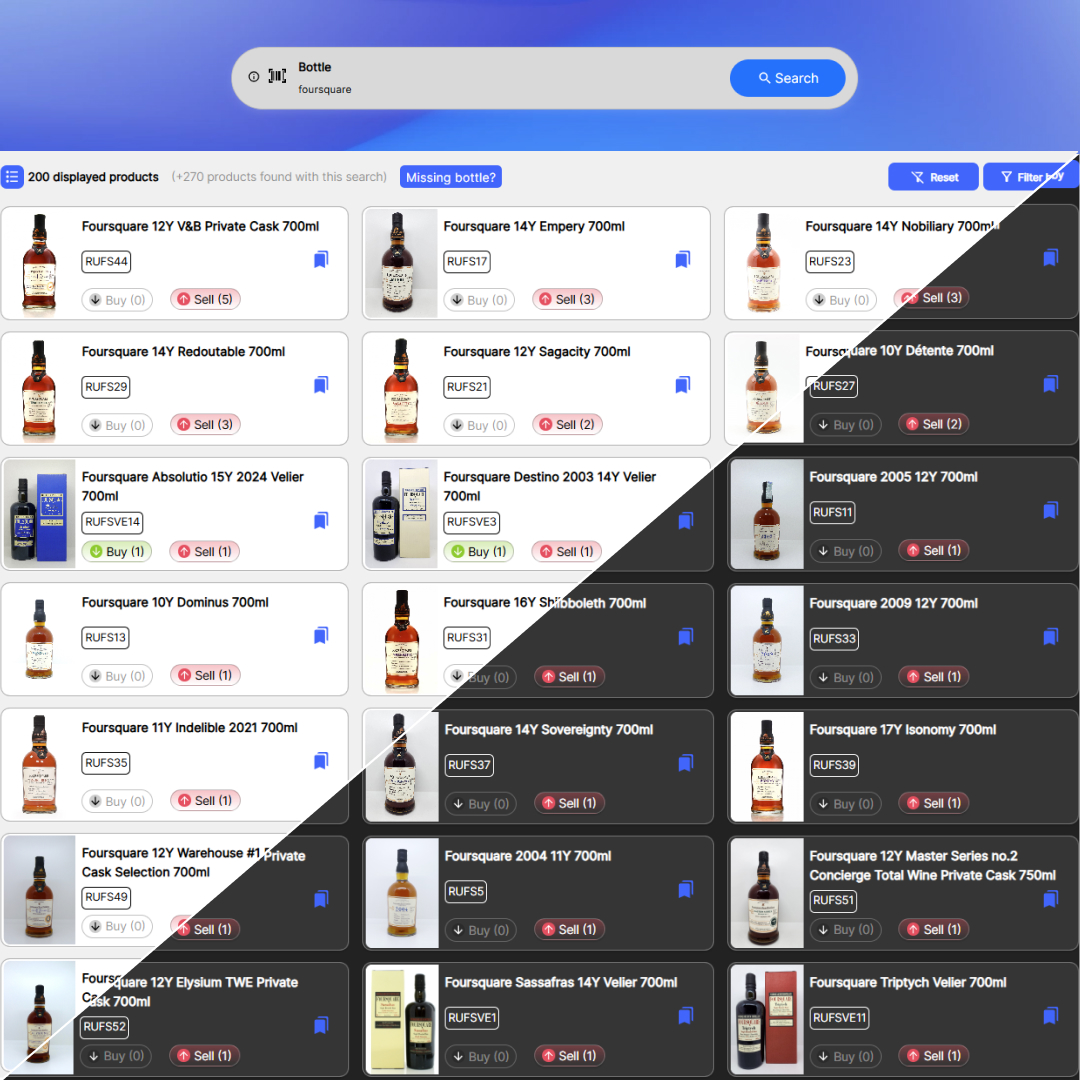
    🔍 A New Way to View Search Results

    We’ve revamped how search results are displayed.

    Say hello to the new card view, a more visual layout that includes a bottle preview directly in the result. Easier to scan, faster to explore.

    Prefer the old-school list view?

    No worries it's still available.

    You can switch between card and list views freely. It’s all about giving you flexibility and control.


    💬 Built with Your Feedback

    What’s most exciting about this release is that it’s powered by you.

    The light mode, the new display options, they’ve been among the most requested features from our community. And we’re just getting started.

    We truly appreciate every comment, message, and suggestion you send our way.

    Keep them coming, we're building this experience together.


    👉 Try the Updates Now

    Dive into the new features, switch things up, and let us know what you think.

    Your feedback keeps shaping what’s next!

    https://thexchangeplatform.io

    Published on :

    Modified on :
    #Whisky

    #Rhum

    #Bourbon

    #Cognac

    #Armagnac

    #Mezcal

    #Tequila

    Ricci Spirits Expands Horizons with New Office and Ambitious Plans

    Ricci Spirits Expands Horizons with New Office and Ambitious Plans


    Grand Opening Set for April 26th

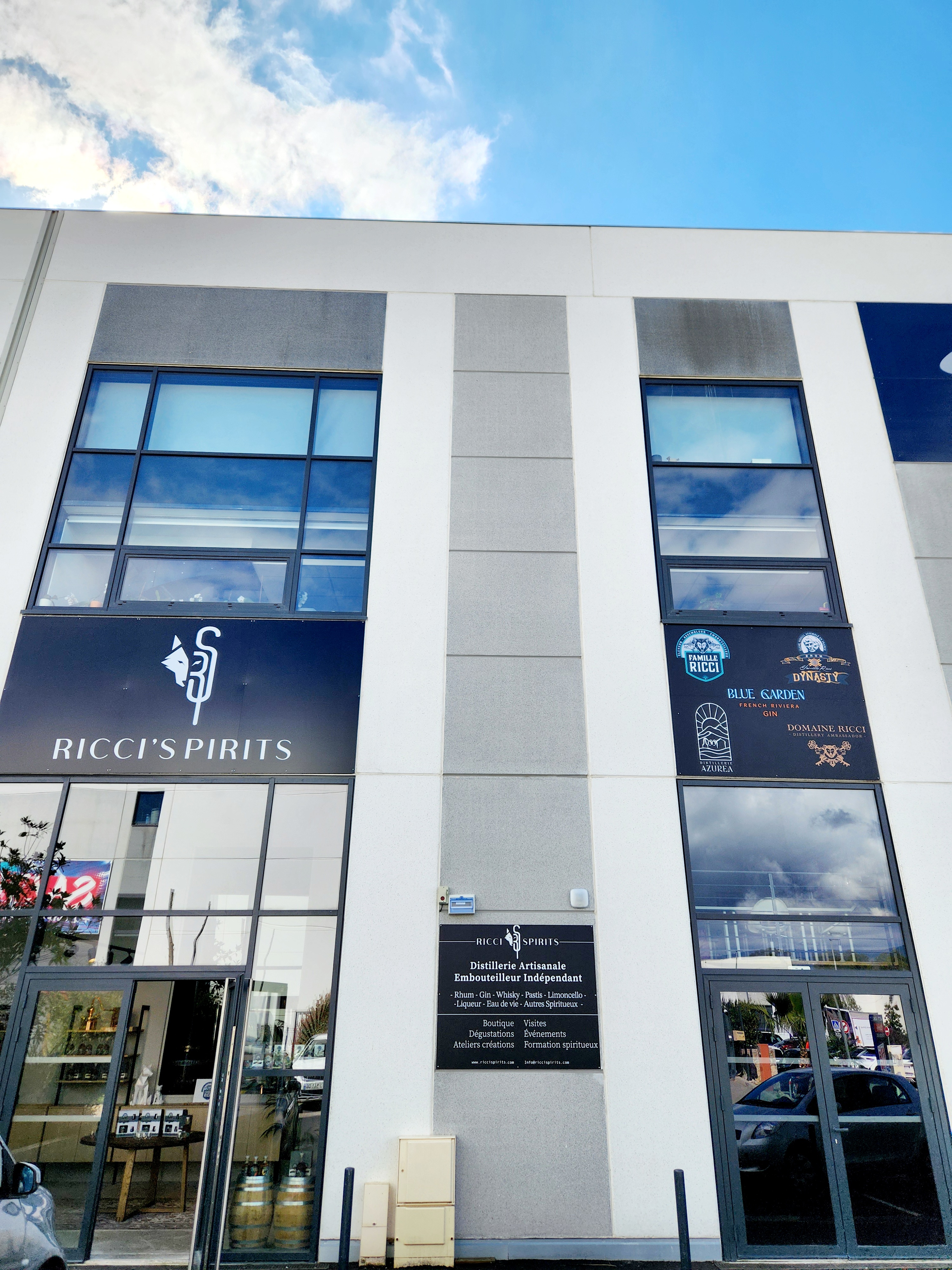
    Ricci Spirits has inaugurated its brand-new office, marking a milestone in the company’s journey. The official grand opening is scheduled for April 26th, and attendance will be strictly by invitation, requiring mandatory booking.

    For those interested, details regarding the invitation process are available at the end of the article.


    An Excellence and a Future of Innovation

    Ricci Spirits still assembly at the new premises is still underway. The company is poised to introduce new and exciting developments in the world of spirits, including a fresh lineup of meticulously crafted beverages.

    Ricci Spirits is the name of the holding company; there will be no bottling under that name, all production will be under Famille Ricci, Domaine Ricci, and the respective brand names produced on-site.


    A Sensory Journey: New Spirits in the Making


    Ricci Spirits is set to launch several unique products, starting with:

    -Gin Blue Garden

    -Pastis Le 132

    -Limoncello Le Méditerranéen

    -Eau de vie & Liqueur from Distillerie Azurea

    The company’s whisky production is also in progress, with initial testing beginning immediately. The first batches are expected to be ready for tasting around September.

    While the official name for the whisky remains undecided, the brand is dedicated to crafting an exceptional product.


    Experiential Offerings: Distillery Visits and Workshops


    Visitors to Ricci Spirits’ new office can look forward to an immersive experience, including:

    -Classic and premium tastings

    -Rum and whisky blending workshops

    -Micro-distillation of gin

    -Potential customized ateliers

    In addition, the second floor of the establishment will serve as a training academy dedicated to all facets of spirits production, distillation, and marketing.

    This initiative is spearheaded by Morgan Ricci and Cyrille Mald, with the goal of fostering knowledge-sharing among industry players.


    Capacity and Special Releases

    The new facility boasts a storage capacity of approximately 200 barrels or 50,000 liters of alcohol. While some special cuvées are in the pipeline, details remain undisclosed for now.


    Strategic Shifts and New Directions

    Domaine Ricci remains committed to its role as a 100% bottling company.

    As part of a strategic revamp, the Zodiac, OVNI, and Exception series will be discontinued. In their place, two new continuous categories will be introduced:


    -Rare Single Cask – Covering the full range, not just ultra-rare releases.

    -Unic Blend – Featuring both aged and white spirits.


    Vanuatu Bottling and the Nabonga Project

    The company is also exploring a Vanuatu bottling project and the creation of a new brand, Nabonga. However, final decisions regarding this initiative are still pending.


    Exciting Releases for Whisky Live

    Domaine Ricci is expected to unveil new releases at Whisky Live, including potential new spirit categories that will further expand the company’s diverse portfolio.

    With its unwavering commitment to quality and innovation, Ricci Spirits is set to redefine the landscape of premium spirits.

    Stay tuned for more updates as they embark on this exciting new chapter.


    26th April Grand Opening booking details:

    Ask Jade at info@riccispirits.com

    Ricci Spirits office details

    609 route de la Roquette

    06250 Mougins

    +33 4 8393 8366


    Famille Ricci

    https://www.facebook.com/FamilleRicciRhum

    https://www.instagram.com/famillericci_rhum

    https://www.famillericci.com/


    Domaine Ricci

    https://www.facebook.com/profile.php?id=61566438238365

    https://www.instagram.com/domainericci


    Ricci Spirits

    https://www.facebook.com/profile.php?id=61572887344083

    Published on :

    Modified on :
    #Eau de vie

    #Liqueur

    #Cognac

    #Armagnac

    #Gin

    #Rum

    TEP Storage Solution is Now Live!

    TEP Storage Solution is Now Live!


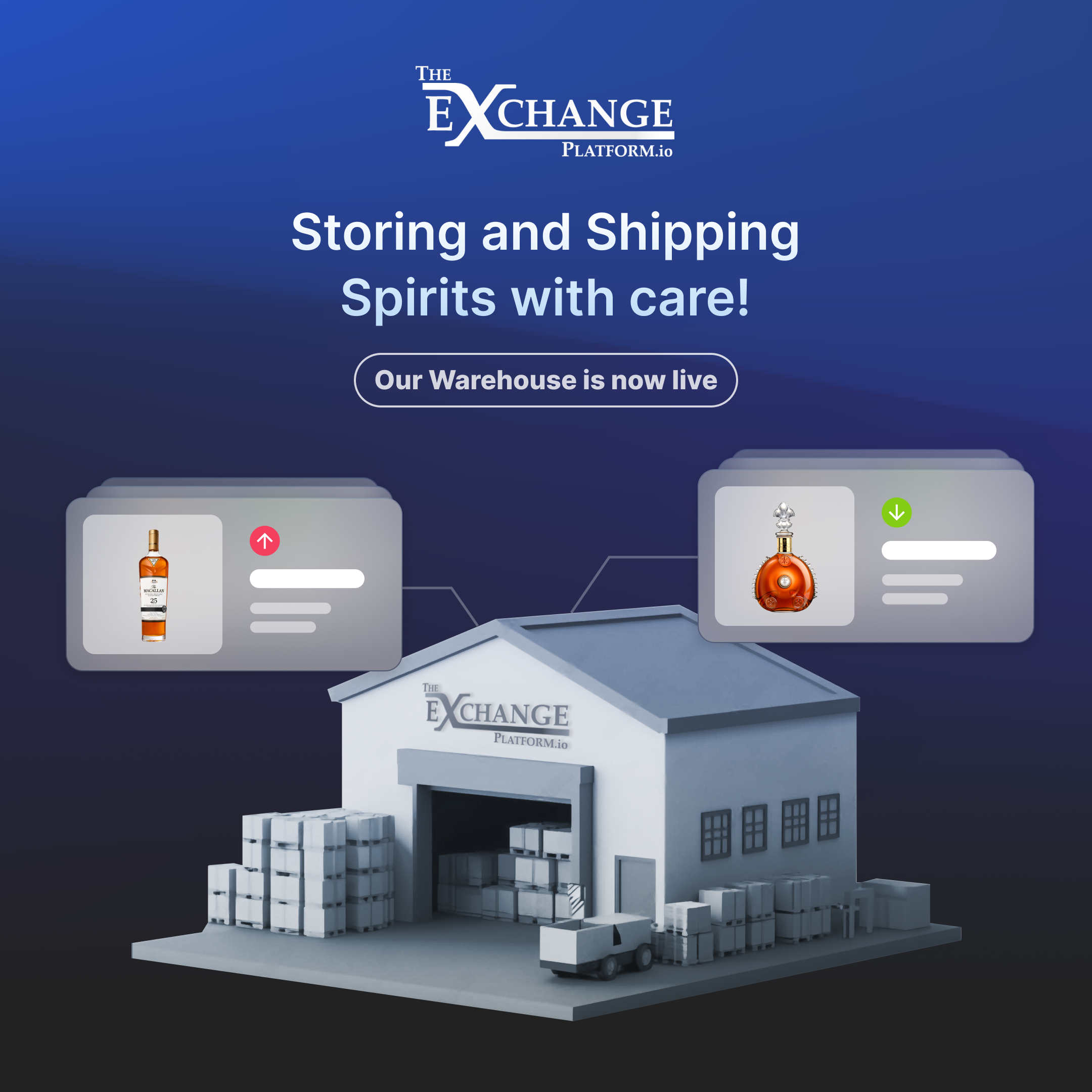
    TEP Storage: Unlock a World of Benefits!

    🔹 Seamless Shipping – Bottles sold within the EU can now be sent directly to our secure warehouse, regardless of the buyer’s location.


    🔹 Global Access Made Easy – Non-EU residents can store their bottles and have them shipped whenever they choose, in full regulatory compliance.


    🔹 Negotiated & Transparent Pricing – Benefit from optimized storage costs with no hidden fees.


    🔹 Flexible Shipping Options – Ship your bottles whenever and wherever you want, hassle-free, directly from our warehouse.


    TEP makes buying, storing, and trading fine spirits easier than ever. This option is available directly when selecting your delivery destination.


    📦 Start storing today and optimize your transactions!


    ✅ Select TEP Warehouse as your delivery destination when purchasing.

    ✅ Your bottles will be securely stored in our facility.

    ✅ A perfect solution to store, optimize costs, protect your collection, and facilitate potential resale.

    ✅ Bottles are automatically insured at their entry value.


     Thank you for your trust over the past months! We will continue adding new features to enhance your experience. We’re here for you—don’t hesitate to reach out!


     On The Exchange Platform, You Can:


    *Buy, sell, or store your bottles

    *Use our browser to access detailed product data

    *Rate and review your tastings with in-depth comments

    *Browse through 70+ sources of price history

    *Stay informed with our news & events feeds

    *Discover your next favorite tasting through our reviews section

    *Track your collection—all in one place!

    Published on :

    #Whisky

    #Rhum

    #Bourbon

    #Rye

    #Cognac

    #Armagnac

    #Chartreuse

    #Mezcal

    #Tequila

    #Rum

    The Vision Behind Cognac Festival: Insights from the Founder

    The Vision Behind Cognac Festival: Insights from the Founder

    Interview with Romain Bodenan: The Vision Behind Cognac Festival


    Who is Romain and why the Cognac Festival?

    Romain Bodenan is a passionate spirits enthusiast who has been exploring the world of fine spirits for over a decade. With countless visits to distilleries and participation in spirits festivals, his journey has been fueled by a love for whisky and a deep desire to share his passion. Romain is also an entrepreneur who founded Ma Dégustation Privée, an initiative born from his frustration with having to travel far for distillery visits or festivals. His vision is to create a comprehensive ecosystem for spirits enthusiasts, encompassing tastings, festivals, and educational opportunities.

    "I found it paradoxical," Romain shares, "that so many people are eager to discover spirits, yet the options for doing so often feel distant and inaccessible. I wanted to build a space where everything comes together under one roof."


    The Cognac Festival: A One-Day Celebration of Spirits

    The inaugural Cognac Festival will take place at La Grande Poste, with up to 36 exhibitors showcasing their best offerings. Currently, 18 exhibitors are confirmed, representing a diverse range of producers, tonnelleries, and associations.

    The event promises a rich experience, with free unlimited tastings, affordable tickets, and all-inclusive access to masterclasses for only 15 EUR. Visitors can look forward to a vibrant day from 10:30 AM to 8:00 PM, with side events potentially happening the night before or later in the evening at local bars.


    Special Features and Experiences


    • Mixology & Food: Romain envisions an innovative mixology school where cocktails are customized with spirits from exhibitors. Alternatively, a dedicated Grande Poste bartender will serve expertly crafted drinks. The food offerings will be led by the Grande Poste’s chef, ensuring a complete gastronomic experience.
    • Masterclasses: Aimed at groups of 25, these sessions will feature exhibitors or industry stakeholders discussing the cognac-making process, from raw materials to bottling.
    • Tasting Freedom: Exhibitors are encouraged to bring as many bottles as they wish, ideally offering 5-6 selections per stand.
    • Glassware & Shop: Glasses will be provided by the BNIC (Bureau National Interprofessionnel du Cognac), and Cave Saint Seurin will handle the event’s retail needs.
    • Special Bottling: A confirmed exclusive bottling will debut at the event, with more potentially in the pipeline (but we can’t give you more details at the moment, just so you know, looks VERY promising)


    Digital Presence

    The Cognac Festival’s website and social media platforms feature dedicated pages for each exhibitor, promoting their work through engaging profiles. Each domain answers three thought-provoking questions about their craft, giving attendees a deeper understanding of their offerings.


    What’s Next?

    Romain dreams of establishing a broader ecosystem and more immersive experiences for spirits lovers. "Whether you're here for the tastings, the education, or simply to enjoy a day celebrating cognac, I want this festival to be the start of something bigger," Romain concludes.


    Get to know more:

    Website: cognacfestival.fr

    Instagram: Cognac Festival

    Facebook: Cognac Festival

    LinkedIn: Cognac Festival


    Don’t miss the opportunity to be part of this unique event!


    Published on :

    Modified on :
    #Eau de vie

    #Cognac

    #Brandy

    #Cocktail

    Functionality Release: Personal Rating & Reviews

    Functionality Release: Personal Rating & Reviews

    Ratings & Reviews Are Live on TEP!

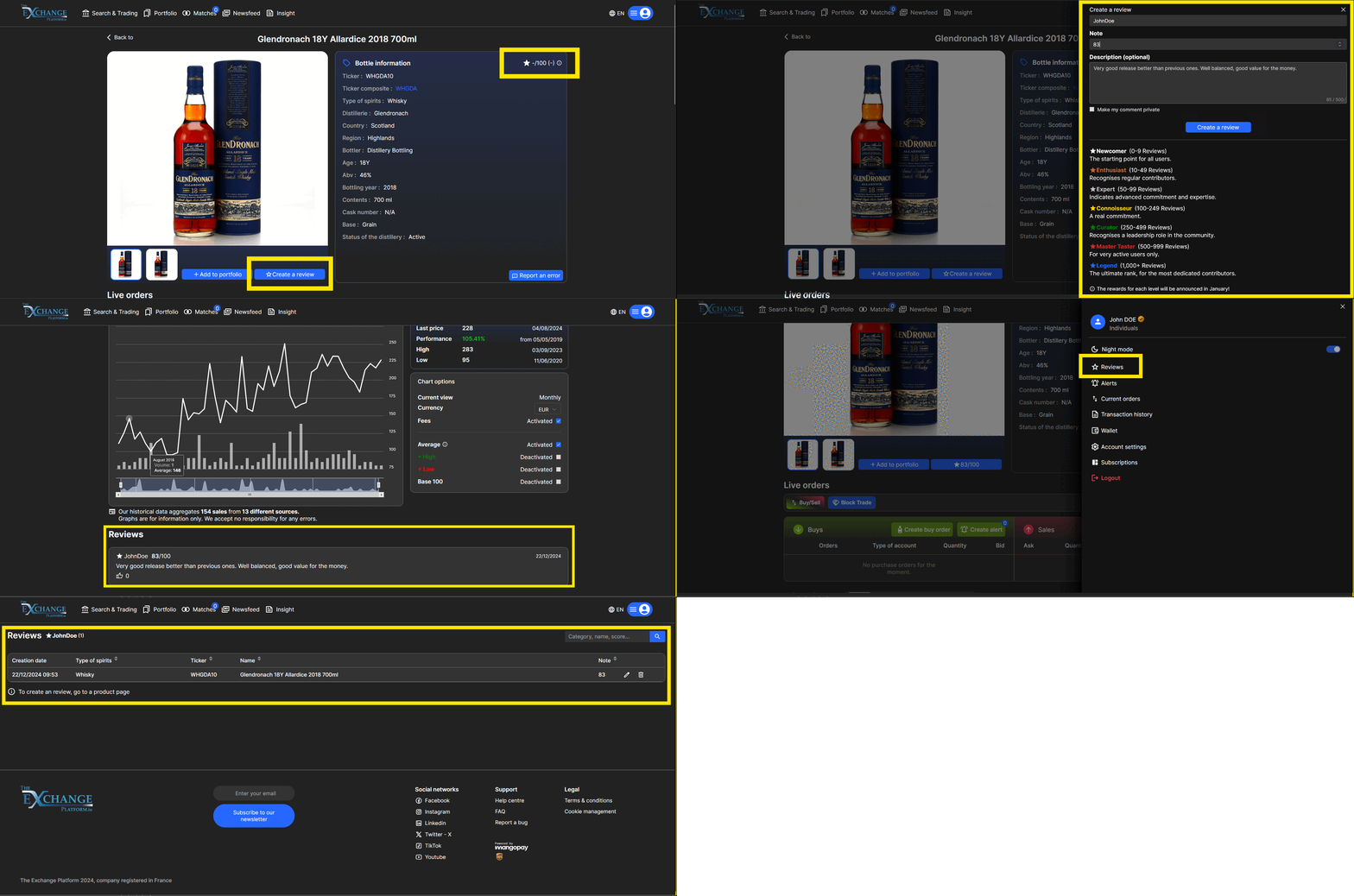
    We’re thrilled to share some exciting news: Ratings and Reviews are now live on The Exchange Platform! This highly requested feature comes in response to numerous feedback from our users, and we’re excited to deliver a tool that enhances your experience and decision-making on the platform.


    Here’s what makes this free feature a game-changer:


    Ratings in Every Corner of TEP: Discover reviews and ratings directly in the search bar and on bottle pages, giving you the insights you need at a glance.

    Review Any Spirit, All in One Place: For the first time ever, you can review any kind of spirit—from whisky to rum, cognac, or even mezcal—under the same roof. No more jumping between platforms!

    Seven Levels of Recognition: We’ve introduced 7 levels of reviewers, each unlocking unique rewards. The more you contribute, the higher you climb so stay tuned, rewards for each level will be unveiled in January!

    Submit Your Existing Reviews: Have you already reviewed spirits elsewhere? Send us your ratings and reviews files and we’ll upload them for free to your TEP profile, making it easy to consolidate everything in one place.


    This feature is a significant step forward in making TEP the most comprehensive and transparent platform for spirits enthusiasts, collectors, and investors.

    Start exploring, reviewing, and climbing the ranks today!


    Take advantage of this highly requested feature starting today.

    Published on :

    Modified on :
    #Whisky

    #Liqueur

    #Agave

    #Rhum

    #Whiskey

    #Bourbon

    #Cognac

    #Armagnac

    #Rum

    Fest'Armagnac 2025: An Elevated Tasting Experience

    Fest'Armagnac 2025: An Elevated Tasting Experience

    After a successful inaugural event, Fest'Armagnac returns for its second edition on March 1, 2025, in Bordeaux's Grand Poste. This year’s event will host 37 exhibitors—up from 26 in 2024—and expects to welcome 750 attendees. With a growing lineup and a 50% increase in attendance, Fest'Armagnac is quickly establishing itself as a top event for enthusiasts of this renowned French spirit.


    Venue & Tasting Highlights

    Returning to the scenic Grand Poste in Bordeaux, visitors will enjoy unlimited tastings from 37 stands, each offering an average of eight bottles. The event focuses on cask strength Armagnac to preserve the spirit’s authentic flavors, with only unmodified Armagnacs allowed. For €10, attendees receive a tasting glass at the entrance, with tastings available from 11:00 am to 7:30 pm.


    Culinary Pairings & On-Site Experiences

    Gastronomic experiences are at the heart of Fest'Armagnac. Kicking off on Friday evening, Ayawasca bar will host a cocktail event featuring Armagnac-based drinks crafted by Hontambere. During the festival, attendees can sample regional foods at Gascony-inspired food stands and enjoy chocolates from Bouchon, made with Armagnac from Domaine Tuilerie. For a more immersive pairing experience, Buibui restaurant will host a Saturday lunch featuring an Armagnac Lacquy food pairing for €40, including festival access (reservations available on the event’s website).


    Masterclasses & Contests

    To enhance Armagnac appreciation, the festival will offer four free masterclasses covering topics like Armagnac history, cask strength, food pairing, and biodynamic practices. A tasting contest will give participants a chance to identify two different Armagnacs. Winners who correctly identify their selection will receive a bottle from the tasting lineup.

    A special bottling will also be available: a 2004 Folle Blanche, cask strength, from Domaine Pouteou.


    Origins & Evolution

    Fest'Armagnac was founded by Michael Illiouz, who observed a growing demand for independent Armagnac bottlers. Inspired by a pivotal conversation with Frédéric Chappe at L’Encantada, Michael embarked on an exploratory journey in the Armagnac region, solidifying connections with distillers and creating the festival to share his knowledge and passion for the spirit.


    Looking Ahead

    If the 2025 edition proves successful, Fest'Armagnac plans to expand further in 2026 with a goal of 40 exhibitors and 1,000 attendees while maintaining its quality standards and single-day format.


    Get to know more on their:

    Website https://festarmagnac.fr

    Facebook https://www.facebook.com/festarmagnac

    Instagram https://www.instagram.com/festarmagnac

    Published on :

    Modified on :

    #Eau de vie

    #Armagnac

    #Brandy

    #Cocktail

    Functionality Release: PayPal is now available!

    Functionality Release: PayPal is now available!

    Let’s kick off the weekend on a positive note with our new update!


    We are thrilled to announce that TEP now accepts PayPal as a payment option!


    This feature has been highly requested by our users, and it is now available!

    You can easily select this payment method during a purchase, alongside other available options.

    We now accept payments via Mastercard, Visa, American Express, PayPal, and wallet payments via bank transfer, all managed by Mangopay.


    We’re continuously unlocking new solutions for our community, so stay tuned for exciting new features coming soon!


    The Exchange Platform team.


    On The Exchange Platform, you can:

    • Use our browser to access descriptive data.
    • Navigate through over 70 sources of price history.
    • Stay informed with our news and events feeds.
    • Discover your next favorite tasting through our review/tasting feed.
    • Monitor your collection, all in one place.

    Published on :

    Modified on :

    #Whisky

    #Liqueur

    #Agave

    #Whiskey

    #Cognac

    #Armagnac

    #Mezcal

    #Tequila

    #Rum

    Toulouse Spirits Festival: A Celebration of All Things Spirits

    Toulouse Spirits Festival: A Celebration of All Things Spirits


    Longtime friends Nicolas and Romain share a deep passion for spirits, rooted in their time living in Martinique and Guadeloupe. What began as a lighthearted hobby—tasting and comparing rums—soon evolved into a serious pursuit. Their frequent visits to local cellars fueled their love for spirits, and their palates expanded as they explored different varieties beyond rum.

    From tasting trips to aging their own spirits in small casks, their journey into the world of spirits grew richer. Initially focused on rum, their network of connections with liquor shops and aficionados naturally led them to explore whisky, gin, and more. Over time, they built relationships with independent brands like Old Brothers, Swell de Spirits, and Famille Ricci.

    Their involvement with spirits didn’t stop at tasting, however. Nicolas and Romain played key roles in organizing events like the Open Spirits Festival and engaging with Facebook communities, further solidifying their standing in the spirits world. After discussions with Swell de Spirits and Ricci at a recent RhumFest 2024, the idea for a new, broader spirits festival in Toulouse was born. While Toulouse already had a whisky festival, there was room for something more inclusive, spanning multiple types

    of spirits.


    A Festival for All Spirits Enthusiasts


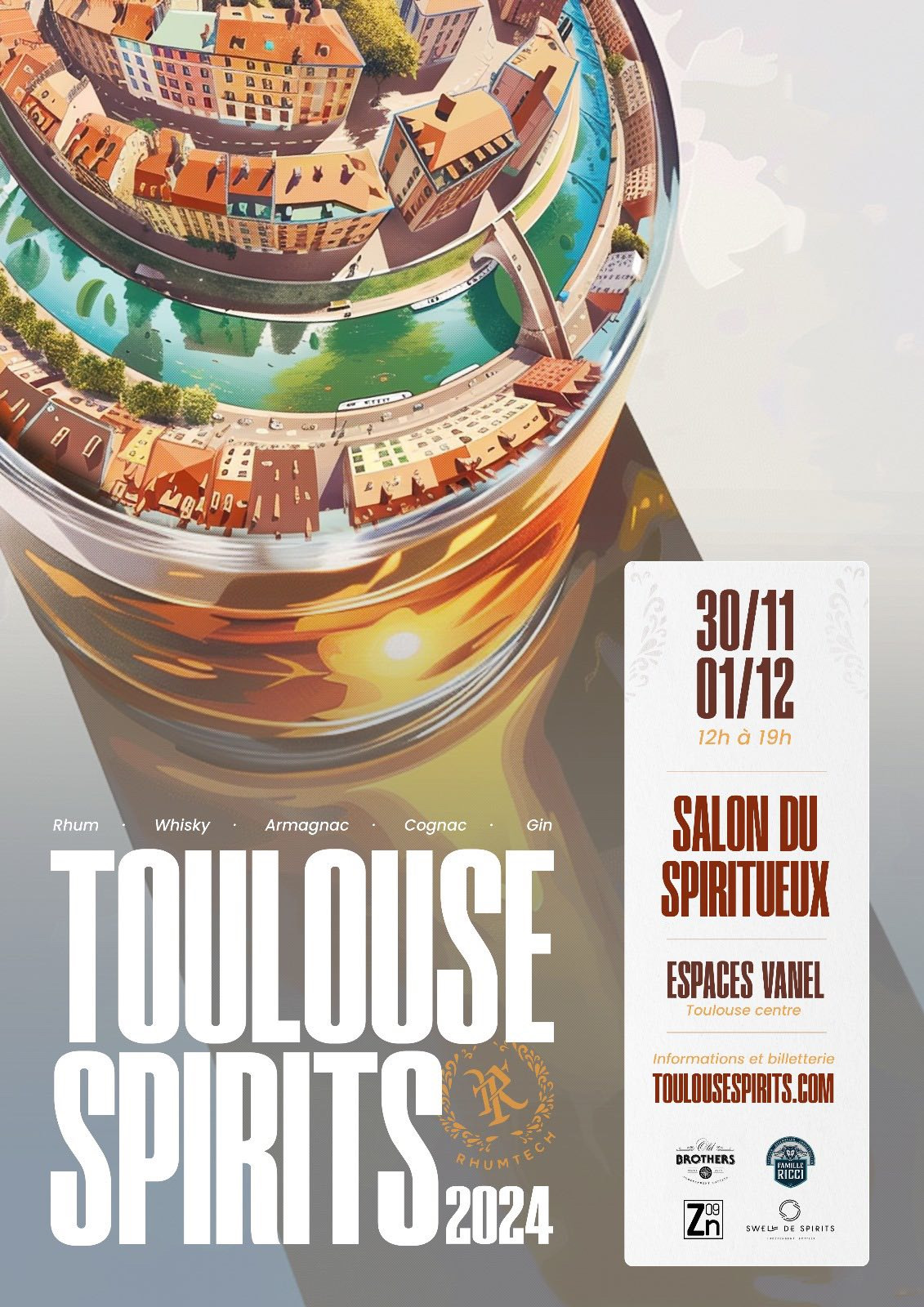
    The inaugural Toulouse Spirits Festival is set to welcome around 1,000 attendees per day over two days. Each visitor will receive a tasting glass to ensure everyone has their own throughout the event. Expect a lineup of 40 to 50 exhibitors, including both large and small producers, with a focus on creating a convivial atmosphere where smaller independent brands can shine.

    The event will feature four exclusive bottlings: two rums, one whisky, and one gin. Attendees will have the chance to taste freely, with no limit to how many bottles they can sample. The focus is on accessibility, offering an affordable yet well-curated experience, without making the event too large or overwhelming.


    More Than Just Spirits


    The festival will offer much more than just tastings. While there won’t be any thematic spaces, exhibitors will showcase what they do best, with a diverse selection of spirits from all over the world. A temporary shop will be available for those looking to bring home their favorite discoveries.

    In terms of food, cold finger foods will be provided, as the venue’s kitchen is not accessible. Despite the logistical challenge of holding the event on the 7th floor, Nicolas and Romain have worked hard to ensure everything runs smoothly. Attendees can also expect a range of festival goodies, including tote bags, hats, t-shirts, caps, and even temporary tattoos.

    While this year’s festival won’t feature masterclasses or VIP areas, there’s potential for these in future editions. There’s also talk of introducing a mixology area and adding even more activities alongside the tastings, like tent displays and glasses that have won the Silver Medal Lépine competition.


    Looking Forward


    Though they had only four months to prepare for the event—starting in late July—Nicolas and Romain managed to pull it together with support from the spirits community. The festival will take place over two days, from 12 PM to 7 PM on Saturday and 12 PM to 6 PM on Sunday. There’s even talk of special parties on Friday and Saturday nights to extend the festivities.

    The duo hopes this first edition will be a success, paving the way for future events. Some exhibitors were disappointed they couldn’t attend due to the rushed scheduling and their packed agendas. However, with the support they’ve received so far, Nicolas and Romain are optimistic that the Toulouse Spirits Festival will become an annual staple for spirits lovers.


    Be sure to mark your calendars for what promises to be a fantastic celebration of the finest spirits in Toulouse, and perhaps even a new favorite event for the spirits community!


    You can learn more and follow them on:

    https://toulousespirits.com

    https://www.instagram.com/toulousespirits

    https://www.linkedin.com/company/rhumtech

    https://www.facebook.com/events/1712997532781413

    https://www.facebook.com/profile.php?id=61565724158681

    Published on :

    #Whisky

    #Eau de vie

    #Rhum

    #Cognac

    #Armagnac

    #Gin

    #Tequila

    Viva Agave: A Celebration of Mexican Spirits in Paris

    Viva Agave: A Celebration of Mexican Spirits in Paris


    Born from a shared passion for Mexican spirits and a desire to elevate their presence in France, the Viva Agave Festival has grown into a key event for agave enthusiasts and professionals alike. Martha, a long-time ambassador of tequila and mezcal in France, has been championing Mexican spirits since 2012. Her mission? To introduce and push these exceptional products outside Mexico while receiving support from within the country to expand their distribution abroad.

    The idea for the festival was sparked by frustration with the limited and unsatisfactory offerings from distributors. In 2018, Martha met David and another agave enthusiast. Together, they realized the immense potential of agave-based spirits, which at the time were still relatively unknown in France.


    A Growing Success


    The first edition of Viva Agave was small and intimate with 15 exhibitors, but by 2019, the festival had expanded. Joined by new partners, Sébastien Gans and Thomas Girard, they professionalized the event. That second edition attracted 20 exhibitors and over 2,000 attendees in just two days, a huge success that confirmed the growing interest in agave spirits in France.

    As 2020 approached, the team debated whether to hold another edition, but then COVID-19 hit, and plans were put on hold. The following years, 2021 and 2022, were challenging, with the pandemic making it difficult to organize large indoor gatherings. Still, the enthusiasm from both attendees and exhibitors never waned.

    In 2023, despite internal challenges due to the increasing professional responsibilities of the team, they received a strong push from the agave community to keep the festival alive. With the booming agave market, Martha and the team decided to move forward, setting the stage for the highly anticipated 2024 edition.


    Bigger and Better in 2024


    This year, the festival has expanded even further, with 25 exhibitors, including some that had to be turned away due to space limitations. Meaning, 1K and Mezcaleria will be too small looking forward. The hope is to find a larger venue for future editions, with plans already in the works for 2025.

    Visitors to the 2024 festival can look forward to a variety of experiences, from tastings to educational masterclasses. El Vecino taqueria will be open, offering authentic Mexican food, while the Maison Villevert corner will be serving a special cocktail, the Paloma, made with tequila, grapefruit, and soda, a total of 4 different cocktails with one based on biodynamic. Entry to the festival includes free tastings, and every attendee will receive an informational booklet and a tasting glass.

    Though the team had hoped to release a special festival batch of agave spirits, the short timeline (four months of preparation) made this impossible for 2024. However, we've challenged Martha to create a unique festival batch for 2025! So, let's make this event even more successful to make it happen!


    What to Expect at Viva Agave 2024


    The 2024 edition will showcase a wide range of Mexican spirits, from tequila, mezcal, raicilla, and bacanora to sotol and other non-agave Mexican products. In addition to agave spirits, there will also be Mexican gin, rum, whisky, and other distillates on display.

    The event will feature two main tasting areas with 25 exhibitors, and the Agavothèque will highlight products not yet distributed outside Mexico, giving importers a chance to discover new treasures. A shop will be available for attendees who want to take a piece of the festival home with them.

    The festival will also host 16 masterclasses over two days, with eight each day. These free masterclasses will be offered on a first-come, first-served basis, allowing visitors to deepen their knowledge of agave spirits and the vibrant Mexican spirit culture.

    Running from 11 AM to 7 PM, Viva Agave 2024 promises to be a can’t-miss event for anyone passionate about Mexican spirits, bringing together the best of the agave world under one roof.


    Join us in celebrating the rich tradition and future of Mexican spirits at Viva Agave 2024!


    You can learn more and follow them on:

    https://toulousespirits.com

    https://www.instagram.com/toulousespirits

    https://www.linkedin.com/company/rhumtech

    https://www.facebook.com/events/1712997532781413

    https://www.facebook.com/profile.php?id=61565724158681

    Published on :

    Modified on :

    #Eau de vie

    #Agave

    #Mezcal

    #Tequila

    #Bacanora

    #Raicilla

    #Sotol

    Functionality Release: Bottle Alerts

    Functionality Release: Bottle Alerts

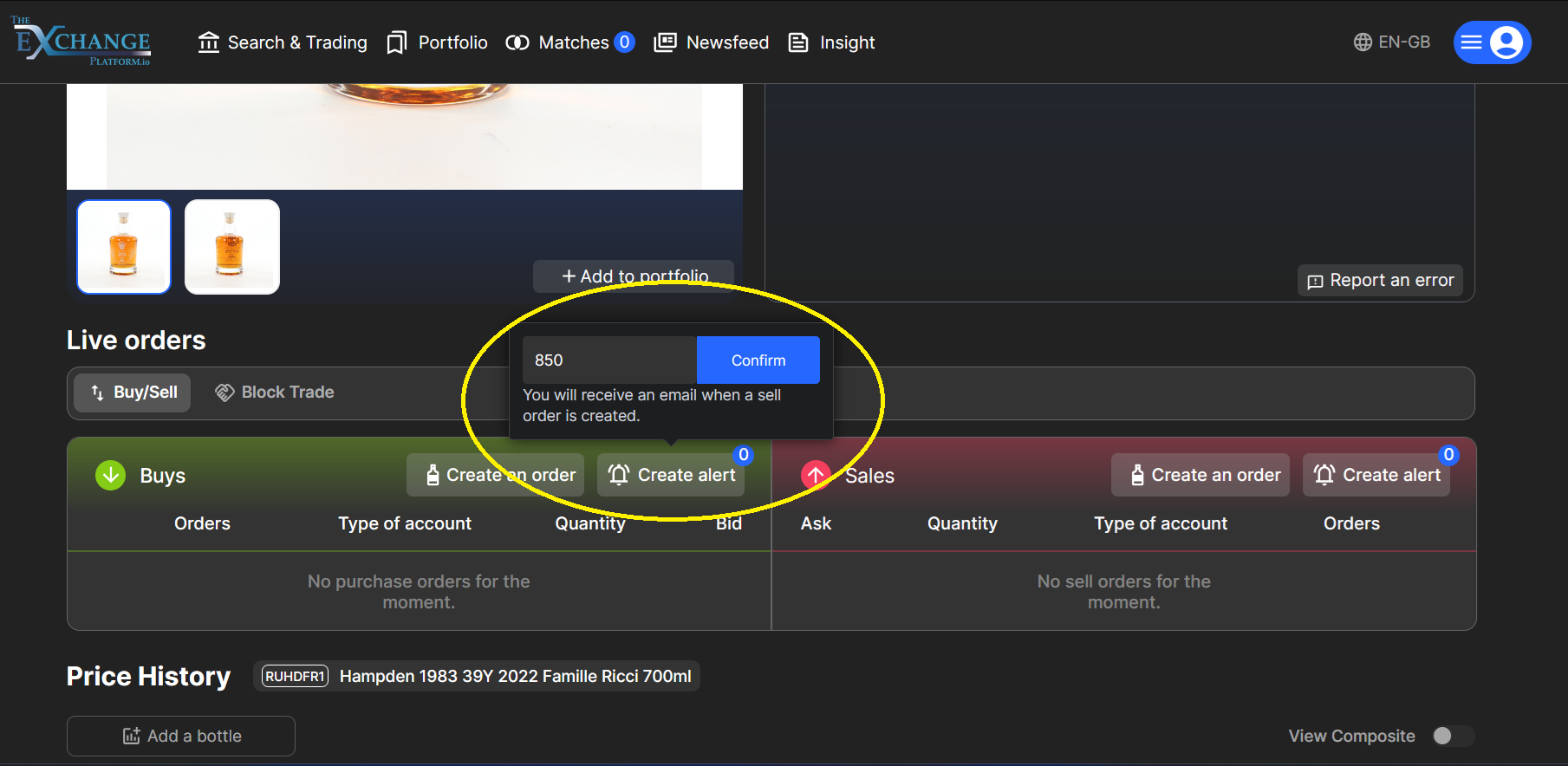
    Bottle alerts are now live! Never miss your target again.


    This highly requested feature is now available to everyone.

    Simply go to any bottle and click the "Create Alert" button in the order book. 

    Set a buy or sell alert with your target price, or create alerts for any listed bottles under a specific ticker.


    In your user menu, we've added an "Alerts" submenu where you can monitor, snooze, modify, or delete your alerts.


    All at no extra cost, this is still a FREE feature!


    Follow the guide below and enjoy seamless trading.


    The Exchange Platform Team


    On The Exchange Platform, you can:

    • Use our browser to access descriptive data.
    • Navigate through over 70 sources of price history.
    • Stay informed with our news and events feeds.
    • Discover your next favorite tasting through our review/tasting feed.
    • Monitor your collection, all in one place.

    Published on :

    #Whisky

    #Liqueur

    #Rhum

    #Whiskey

    #Bourbon

    #Cognac

    #Armagnac

    #Chartreuse

    #Mezcal

    #Tequila

    #Rum

    Julian, aka UnOuDeuxVerres, tried TEP for the first time.

    Julian, aka UnOuDeuxVerres, tried TEP for the first time.

    Today, Julian, aka UnOuDeuxVerres, tried TEP for the first time.

    He shares his feedback on our workflow and features.

    Enjoy his short presentation clip!

    The video is in French, but subtitles are available on our YouTube channel 👉 https://rb.gy/4icewy


    You can also find him on:

    https://www.tiktok.com/@unoudeuxverres

    https://www.instagram.com/unoudeuxverres/

    Published on :

    Modified on :

    #Whisky

    #Bourbon

    #Cognac

    #Armagnac

    #Brandy

    #Chartreuse

    #Tequila

    #Rum

    #Ron

    The Exchange Platform & Spirits Museum cross interview

    The Exchange Platform & Spirits Museum cross interview

    We had the opportunity to have a quick chat with Sven Brosens, the creator of the Spirits Museum.

    We found it interesting to ask him a few questions about the museum and his journey. It turned into a fascinating exchange where he also asked us to explain what we do.

    What could make more sense for us than to talk about spirits with the creator of the Spirits Museum? Let's embark on this!


    Sven, who are you and who is behind the museum?


    I'm a newcomer to the world of spirits, but I've always been interested in them. During the Covid pandemic, instead of pursuing further professional training, I decided to complete the Spirits Sommelier course and then added the WSET Level 3 in Spirits the following year. Since 2023, I have been the President of the Rum Club Switzerland and a member of two other associations: the Whisky and Schnapps Forum Switzerland.


    Why was the museum created and why in Switzerland? What can we find there?


    The idea for the museum was born during my sommelier training. Instead of opening a bar, I wanted to share more knowledge about all types of spirits. I searched for a suitable location for two years and finally found one in Belp at the end of 2023. In the museum, visitors can learn about the history and production of various categories of spirits. Of course, you can also taste the many bottles on display and broaden your horizons.


    Looking ahead, what do you expect?


    The museum is fully equipped, and I am now waiting for authorization to open, hopefully in July. I expect to attract curious individuals who want to learn about new spirits as well as professionals seeking to expand their knowledge and taste spirits from different categories.


    How can the community help?


    The community can help preserve the history of spirits and distilleries by contributing old and new bottles, utensils, tools, barrels, bar equipment, books, and anything related to spirits. For companies interested in exhibiting their products in the museum, I have an exhibition concept that I would be happy to share.


    What's your favorite spirit?


    I started with rum and have remained loyal to it, from white Bacardi with cola to premium dark rums and single cask bottlings at cask strength. My absolute favorite bottle is "The Last" from the Caroni Distillery. I now also enjoy Armagnac and Mezcal. Thanks to the museum idea, I try to find exceptional liquids in all categories.


    Where can we meet you in the future? Any upcoming spirits events? Are there any upcoming events, partnerships, or educational purposes?


    In the future, you can certainly meet me at the museum, where visitors can explore the world of spirits or participate in tastings or seminars. I will also be present at many trade fairs in Switzerland and abroad, such as Whisky Live Paris. Additionally, companies will have the opportunity to organize their own events at the museum.


    Now let's talk about you guys at The Exchange Platform.


    Can you explain who you are and how did you get into the spirits business?


    I’m a long-time spirits enthusiast, born and raised in France. After living abroad for a few years, I continued to enjoy spirits globally with a strong passion for Cognac, Whisky, and Rum. I ended up in this business inadvertently when people began asking me to help them locate bottles they couldn't find and realized there’s definitely something to be done when it comes to locating a bottle and determining its fair valuation.


    Why did you come up with the idea for this platform?


    We realized that the secondary market for spirits is outdated, inefficient, and illiquid, with high execution costs and fragmented information. I looked at what was working in other industries and applied those principles to the spirits market.


    What does your project involve and who are the potential customers?


    The Exchange Platform (TEP) is built on four foundations:

    - Price History: We aggregate data from over 70 auction sources for all types of spirits, plus our own traded prices. Each bottle is standardized with a unique identifier, often linked to a barcode, making searching and comparison easier.

    - Trading: We empower buyers and sellers to set their own prices, shifting away from a seller-driven market.

    - Portfolio Management: We’ve developed a unique tool that allows users to monitor their collection, inventory, or investments with flexibility and powerful analytics.

    - News, Events, Insights: We curate relevant spirits news and events through a dedicated newsfeed and custom filters. Additionally, we publish research and insights through our new Insights function.


    How do you ensure the platform is scam-free?


    Hahaha, I guess you’re referring to the curses and threats I’ve received from scammers on Facebook. Since security is in our DNA and we use Mangopay, a regulated payment provider in the EU, all participants must undergo a one-time KYC (Know Your Customer) process to confirm their identity. Payments are handled within Mangopay’s ecosystem, so sellers only receive funds once the parcel is delivered and confirmed.


    What makes your platform better than others?


    Honestly? Everything! (laughing) More seriously, we offer the only one-stop platform where you can enjoy a dedicated newsfeed, browse spirits events worldwide, search for bottles, explore price history, notify the market of your buying interests, swap bottles, and monitor your position. All of this is within a secure workflow, from registration to payment and delivery, as we have integrated UPS secured parcels. On top of that, we have marginal fee at 2.5%, VAT included.

    There's no need to look for auctions, find a blog, hope to get prices from somewhere, or be stuck in groups. You can access everything at The Exchange Platform.


    Thanks for your time, Sven, and I hope there will be a huge party for the museum opening!


    You can follow and learn more about the Spirits Museum on their website and social networks:

    https://spirits-museum.ch/

    https://www.instagram.com/schnapschat/

    https://www.facebook.com/Spiritsmuseum

    https://www.youtube.com/@spirits-museum

    Published on :

    #Whisky

    #Eau de vie

    #American Whisky

    #Cognac

    #Armagnac

    #Brandy

    #Gin

    #Mezcal

    #Tequila

    #Rum

    #Ron

    Functionality Release: Worldwide Spirits Events Browser

    Functionality Release: Worldwide Spirits Events Browser

    We are delighted to announce that the Worldwide Spirits Events Browser is now live!

    You can now effortlessly search for and plan to attend any spirits show around the globe.

    Our sophisticated filters allow you to refine your search by keyword, country, city, date, or type of spirit, ensuring that you find events that perfectly match your preferences.

    Access is granted without the need to log in.


    On The Exchange Platform, you now have the capability to:

    -Utilize our browser to access detailed descriptions

    -Explore over 60 sources of price history

    -Stay updated with our comprehensive newsfeed

    -Discover spirits shows and events

    -Find your next favorite spirit through our review and tasting feed

    -Manage and monitor your collection all in one place


    We are dedicated to providing a thorough and intuitive experience for all your spirits-related needs.

    Kind regards and enjoy,

    The Exchange Platform Team


    #TheExchangePlatform #Spirits #Spiritueux #Rhum #Rum #Whisky #Bourbon #Cognac #Armagnac #Brandy #Swap #Trade #PortfolioManagement

    Published on :

    #Whisky

    #Liqueur

    #Rhum

    #Whiskey

    #Cognac

    #Armagnac

    #Brandy

    Functionality Release: Portfolio Management

    Functionality Release: Portfolio Management

    We're excited to announce another milestone release today: Portfolio Management is now live!

    With this new feature, you can monitor and evaluate all your bottles, regardless of the spirit type, in one place.

    Utilize our spot and historical metrics calculations to track your collection's performance.

    Enjoy the flexibility of our highly customizable PORT interface, where you can choose from 19 different columns to display exactly what you want to see.

    Tailor it to meet your specific needs and preferences!Now that Portfolio Management is live, the next step is trading.

    Get ready by completing your KYC process, and soon you'll be able to buy, sell, or swap bottles directly through our platform.


    On The Exchange Platform, you can already:

    -Use our browser and access descriptive data

    -Navigate through our 50+ price history sources

    -Stay informed with our newsfeed

    -Discover your next favorite pour with our review/tasting feed

    -Monitor your collection, all in one place

    We're committed to providing a comprehensive and user-friendly experience for all your spirits-related needs.


    Cheers to easier portfolio management!

    The Exchange Platform team


    #thexchangeplatform #spirits #spiritueux #Rhum #rum #whisky #bourbon #cognac #armagnac #brandy #swap #trade #portfoliomanagement

    Published on :

    #Whisky

    #Liqueur

    #Rhum

    #Bourbon

    #Cognac

    #Armagnac

    #Brandy

    #Mezcal

    #Tequila

    #Rum

    Functionality Release: Newsfeed & Tasting Reviews Feed

    Functionality Release: Newsfeed & Tasting Reviews Feed

    Exciting new TEP feature is live!

    We are thrilled to announce the launch of our FREE newsfeed & tasting reviews feed on spirits!

    Now, you have access to a curated news feed on the spirits universe. Additionally, because we know you love reviews, we've introduced a Reviews feed.

    You don't even need to be logged in to enjoy it.

    More functionalities will be rolled out in the next days and weeks, so stay tuned and check The Exchange Platform.

    For any questions or remarks, reach out to us.

    Thanks and enjoy!

    The Exchange Platform team.


    #thexchangeplatform #spirits #spiritueux #Rhum #rum #whisky #bourbon #cognac #armagnac #brandy #swap #trade

    Published on :

    #Whisky

    #Liqueur

    #Rhum

    #Cognac

    #Armagnac

    #Brandy

    #Mezcal

    #Tequila

    The Exchange Platform Go-Live Announcement

    The Exchange Platform Go-Live Announcement

    WE ARE LIVE!

    This long-awaited moment has finally arrived to our great pleasure.

    You can now access the site, create your free account, search within our browser for bottles, and take advantage of delayed or real-time price histories with a subscription.

    But above all, complete and have your account verified through our payment service provider Mangopay's interface to enjoy our buying/selling/swapping features!

    The transactional part will be open in a few days to allow us to absorb the new flow of account certifications.

    Get ready to post your interests in all types of spirits!

    Many features are coming in the weeks ahead, and a crucial milestone will be reached by the end of the quarter!

    https://thexchangeplatform.io


    #thexchangeplatform #spirits #spiritueux #Rhum #rum #whisky #bourbon #cognac #armagnac #brandy #swap #trade

    Published on :

    #Whisky

    #Eau de vie

    #Liqueur

    #Agave

    #Rhum

    #Whiskey

    #Rye

    #American Whisky

    #Cognac

    #Armagnac

    #Brandy

    #Chartreuse

    #Baijiu

    #Mezcal

    #Tequila

    #Rum

    #Ron

    #Cachaca